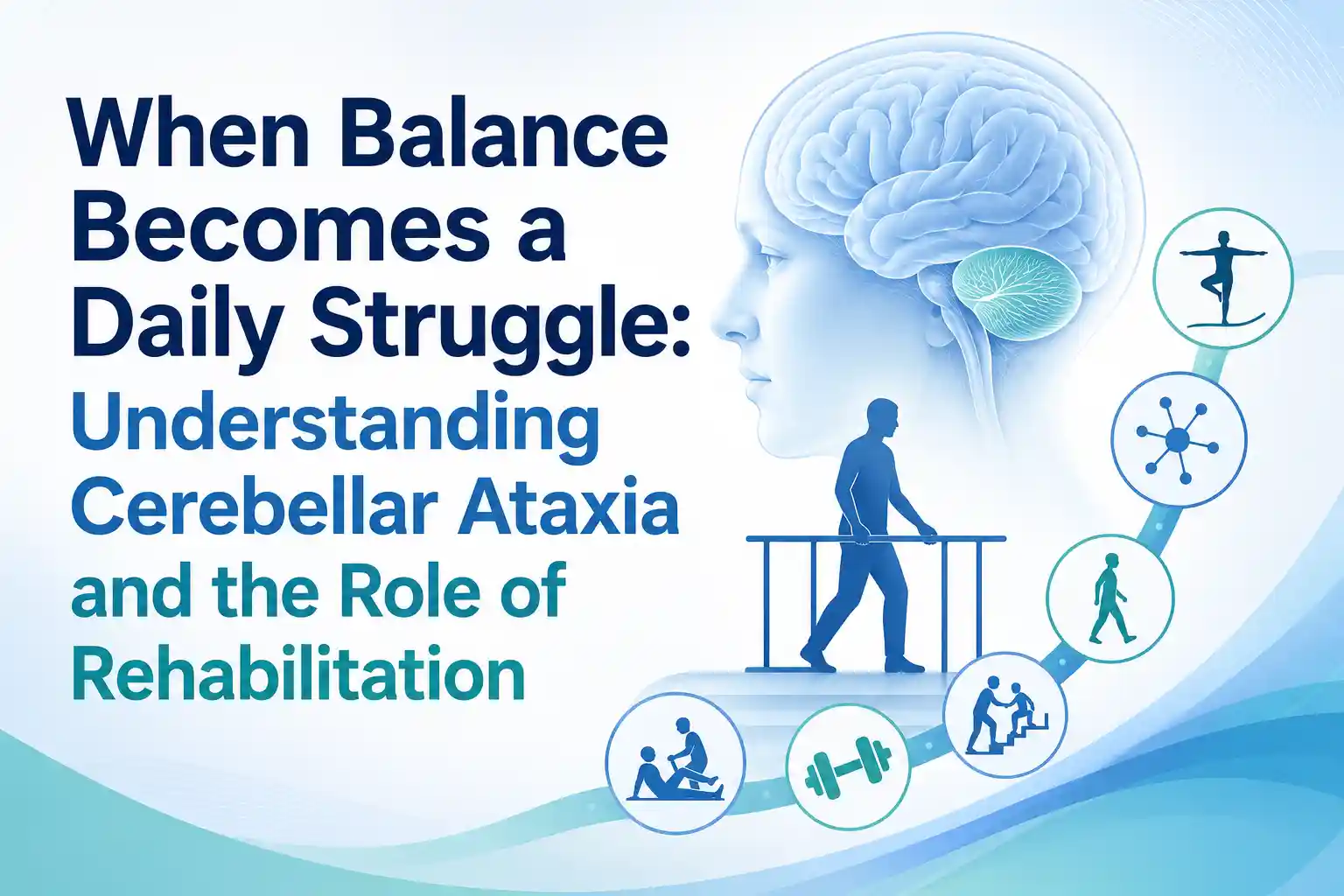
When Balance Becomes a Daily Struggle: Understanding Cerebellar Ataxia and the Role of Rehabilitation


Dr. Krutika Bhadane
PT (Neuro), BPTh, MPTh (Neurosciences), 3+ years clinical
experience in neurological rehabilitation
When Balance Becomes a Daily Struggle: Understanding Cerebellar Ataxia and the Role of Rehabilitation
As a neuro physiotherapist, every patient teaches me something new. Recently, I had the opportunity to work with a patient whose life changed significantly after a fall-related head injury. What initially seemed like a routine recovery gradually revealed a much more complex neurological challenge.
She began experiencing persistent dizziness, imbalance, constant ringing sensations, difficulty coordinating her upper limb movements, involuntary movements, nystagmus, positional vertigo (BPPV), and dysmetria, making even simple day-to-day activities frustrating and exhausting. Tasks that most of us perform without thinking suddenly require immense concentration and effort.
This experience reminded me how profoundly Cerebellar Dysfunction can affect an individual's independence, confidence, and quality of life.
Understanding Cerebellar Ataxia
The cerebellum plays a crucial role in coordinating movement, maintaining balance, regulating posture, and ensuring smooth execution of voluntary activities. When this area of the brain is affected due to trauma, stroke, infection, tumor, or degenerative conditions, an individual may develop cerebellar ataxia.
People living with cerebellar ataxia may experience:
- Unsteady gait and balance difficulties
- Poor coordination of upper and lower limbs
- Difficulty performing precise movements
- Dysmetria (overshooting or undershooting a target)
- Tremors during movement
- Nystagmus and visual disturbances
- Dizziness and vertigo
- Increased risk of falls
These symptoms often impact not only physical function but also confidence in performing everyday activities.
The Rehabilitation Journey
Following a detailed assessment, a structured rehabilitation program was designed based on the patient's specific impairments and functional goals. Every neurological patient presents differently, and therefore rehabilitation must always be individualized rather than protocol-driven.
The treatment plan focused on multiple aspects of recovery, including vestibular rehabilitation for dizziness and positional vertigo, coordination training to improve movement accuracy, balance and gait training to reduce fall risk, and task-oriented activities to enhance functional independence.
Exercises targeting hand-eye coordination, reaching activities, multidirectional weight shifts, dynamic balance tasks, gaze stabilization exercises, and functional movement training formed an important part of the rehabilitation process. A customized home exercise program was also prescribed to encourage consistent practice outside therapy sessions.
Rather than focusing solely on symptom reduction, the goal was to help the patient regain confidence in movement and improve her ability to participate in daily life.
Small Steps, Meaningful Outcomes
One thing I have learned through neurological rehabilitation is that meaningful progress is often built through small, consistent efforts. Every session, every exercise, and every challenge overcome contributes to the larger picture of recovery.
Over approximately two months of structured rehabilitation and the patient's dedication towards therapy, noticeable improvements were observed in her balance, coordination, functional abilities, and overall confidence. More importantly, she reported significant relief in symptoms that had previously affected her daily life.
As therapists, we celebrate functional gains, but what stays with us the most are the moments when patients tell us they feel more confident, more independent, and more like themselves again. Seeing her leave with a smile and renewed confidence was incredibly rewarding and served as a reminder of why neurorehabilitation is such a meaningful field.
The Importance of Early Intervention
Symptoms such as persistent dizziness, imbalance, involuntary eye movements, coordination difficulties, unexplained falls, or challenges with everyday tasks should never be ignored. Early assessment and targeted rehabilitation can play a crucial role in improving function and preventing further complications.
Awareness is especially important because many individuals assume these symptoms will resolve on their own or are simply part of aging or fatigue. Seeking professional evaluation at the right time can make a significant difference in recovery and quality of life.
Final Thoughts
Cerebellar ataxia can be challenging, both for the individual experiencing it and for their family. However, with appropriate assessment, evidence-based rehabilitation, patient commitment, and a structured treatment approach, meaningful improvements are possible.
If you or someone around you experiences symptoms such as persistent dizziness, imbalance, coordination difficulties, involuntary movements, or recurrent falls following a neurological condition or head injury, do not ignore them. Timely neuro physiotherapy assessment and rehabilitation may help improve function, confidence, and overall quality of life.
Every step toward better balance is a step toward greater independence.
References
1. Marquer A, Barbieri G, Pérennou D. (2014).
The assessment and
treatment of postural disorders in cerebellar ataxia: A systematic
review. Annals of Physical and Rehabilitation Medicine, 57(2), 67–78.
DOI: 10.1016/j.rehab.2014.01.002
2. Bastian AJ. (2011).
Moving, sensing and
learning with cerebellar damage. Current Opinion in Neurobiology, 21(4),
596–601.
3. Chien HF, et al. (2022).
Rehabilitation in
patients with cerebellar ataxias. Arquivos de Neuro-Psiquiatria,
80(Suppl 1).
.webp)