Early Intervention in Cerebral Palsy: How Pediatric Physiotherapy Shapes a Child's Future


Dr. Arpita Ganguly
BPT, MPT (Neuro), 6+ years clinical
experience in neuro rehabilitation & functional recovery
Priya remembers the exact moment her world shifted. Her six-month-old daughter, Anaya, was lying on the play mat during her monthly checkup. The pediatrician asked her to roll over. Anaya tried. Her little face scrunched up with effort, but her body did not cooperate the way other babies' bodies did. Her left arm stayed tucked against her chest. Her right leg moved stiffly.
"Does she always keep that hand closed?" the doctor asked gently.
Priya's heart sank. She had noticed. Of course she had noticed. But she had convinced herself it was nothing. Babies develop at different speeds, right? Her mother-in-law had told her not to worry. Her friends said boys develop slower than girls, and every child is unique. But sitting in that clinic room in Kharadi, watching her baby struggle with something that should come naturally, Priya knew. Something was different about Anaya.
What Priya did not know then was that she was standing at the edge of the most important window of opportunity in her daughter's entire life. The next 18 months would not just shape Anaya's ability to walk or use her hands. They would literally rewire her brain in ways that could never be replicated again.
Cerebral palsy is a group of disorders affecting movement, muscle tone, and posture caused by damage to the developing brain, most often before birth.
This is Anaya's story. But it is also the story of thousands of families in Pune and across India who face the same terrifying question: What happens next? More importantly, what can we do right now to give our child the best possible future?
Why the First 1000 Days Are Everything (And Nobody Talks About It)

Here is something that will surprise you. Your child's brain will never be more powerful, more adaptable, or more ready to learn than it is right now in these early years.
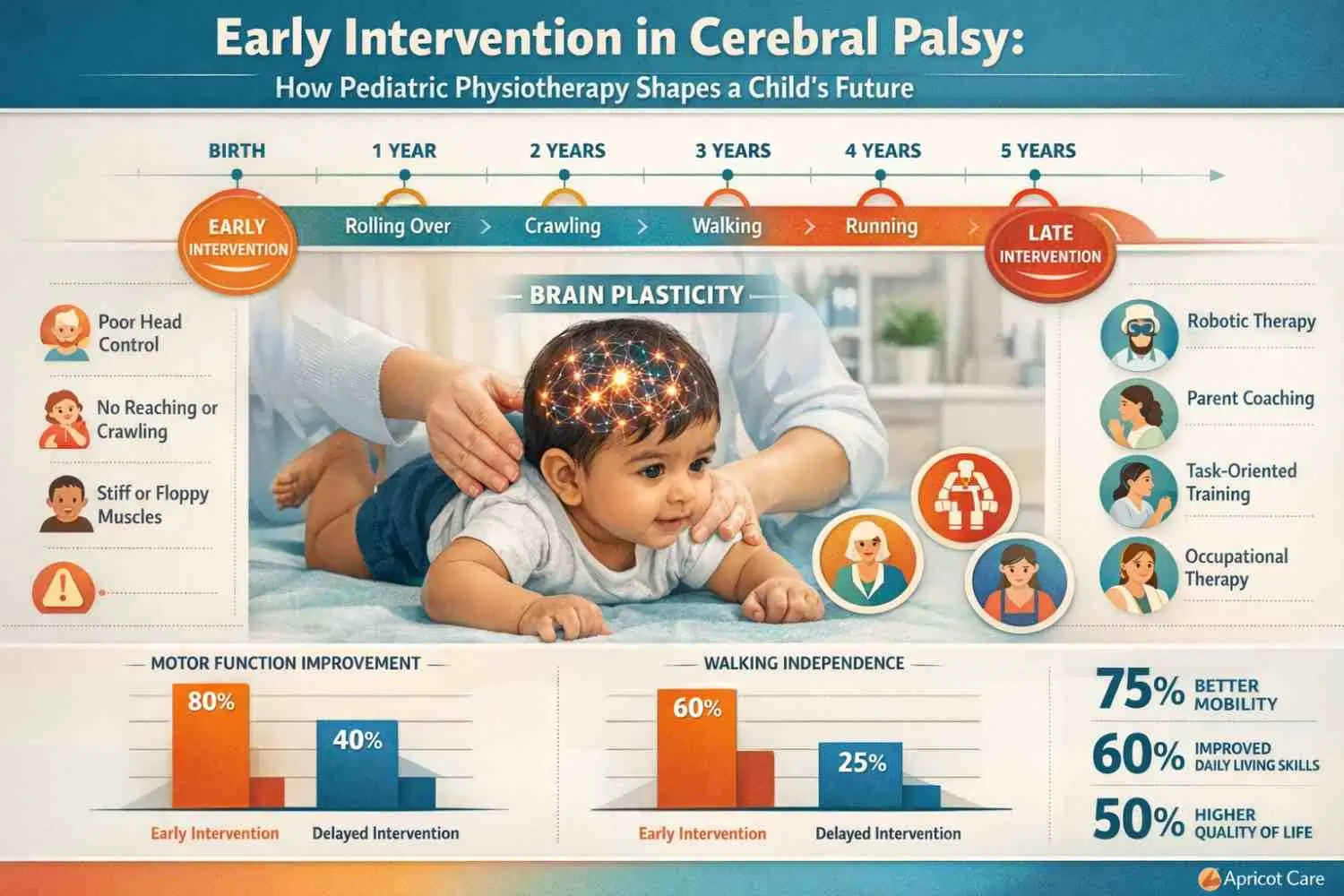
Scientists call it the "first 1000 days." This period stretches from conception through your child's second birthday. During this time, your baby's brain is growing faster than at any other point in their entire life. Every single second, their brain creates one million new neural connections.
Think about that for a moment. One million connections. Every second.
The Brain That Builds Itself
At birth, your baby's brain has about 100 billion neurons. By age two or three, their brain has formed more connections between these neurons than an adult brain has. Yes, you read that right. Your toddler's brain is actually more complex than yours.
But here is the catch. Around age three, the brain starts a process called synaptic pruning. It is like a gardener cutting away branches that are not being used. The connections your child uses regularly get stronger. The ones they do not use disappear forever.
This is why early intervention in cerebral palsy is not just helpful. It is urgent.
Dr. Karen Pape, a renowned pediatric neurologist, discovered something fascinating. Some children with cerebral palsy can run better than they can walk. Why? Because they learned to run during a different developmental window than walking. Their brain wired those movements differently.
What does this mean for parents? Every movement pattern your child practices today becomes hardwired into their brain. If they practice inefficient movement patterns because of spasticity or weakness, those inefficient patterns become their normal. The longer they practice the wrong patterns, the harder it becomes to rewire them later.
This is what therapists call the "maladaptive pattern trap." The brain damage from cerebral palsy does not get worse. But without intervention, the movement problems can actually get worse as children reinforce poor movement habits.
What Most Clinics Do Not Tell You About Early Intervention
When Priya started researching cerebral palsy treatment in Pune, she found the same information repeated everywhere. Therapy helps. Start early. Work with specialists. But nobody explained what early intervention actually looks like in real life.
You Are Your Child's Most Important Therapist
Here is the truth that transforms everything. The therapist you hire is not your child's primary therapist. You are.
This might sound scary. You did not go to physiotherapy school. You do not have medical training. How can you possibly be the most important person in your child's therapy?
Because you are with your child 24 hours a day, seven days a week. A physiotherapist might work with your child for one or two hours a week. You have every feeding, every diaper change, every bath time, every play session, and every moment in between.
Modern research shows that parent coaching is the most effective element of early intervention programs. When parents learn to integrate therapeutic activities into daily routines, children make dramatically better progress.
This approach is called family-centered care. At the neuro rehabilitation centre in pune, like Apricot Care, therapists do not just work on the child. They teach parents how to turn every daily activity into a therapeutic opportunity.
What This Looks Like in Real Life
Let me give you concrete examples:
During Feeding Time:
- Position your baby so their head is centered and stable
- Support their jaw to help with sucking and swallowing
- Use this time to work on head control and trunk stability
During Bath Time:
- The warm water relaxes tight muscles
- Practice reaching for toys floating in the bath
- Work on weight shifting and balance while sitting
During Diaper Changes:
- Encourage your baby to help by lifting their bottom
- Practice bringing hands to midline
- Work on rolling from back to tummy
During Play:
- Position toys just out of easy reach to encourage movement
- Use colorful, interesting toys to motivate effort
- Create "just right challenges" that are hard but achievable
Every single one of these moments is therapy. When you add them all up, your child gets hours of high-quality intervention every single day, not just the hour or two at the clinic.
The Science of the "Just Right Challenge"
Your child's brain learns through challenge. But not just any challenge. The activity needs to be interesting enough to engage them, hard enough to require effort, but not so hard that they give up in frustration.
Therapists call this the "just right challenge." It is the sweet spot where learning happens.
Here is what this looks like at different ages:
0 to 6 Months:
- Tummy time with toys at eye level
- Supported sitting with interesting objects to reach for
- Side-lying play to bring hands together
- Rolling from back to side with gentle assistance
6 to 12 Months:
- Reaching across the body for toys
- Transitioning from sitting to hands and knees
- Weight bearing on hands and feet
- Playing with both hands together
12 to 24 Months:
- Practicing standing with support
- Cruising along furniture
- Stepping over small obstacles
- Picking up small objects with fingers
Notice something important here. These are not random exercises. They are functional activities that help your child explore their world and develop independence.
The Interventions That Actually Work (And the Ones That Do Not)
Not all therapy approaches are created equal. Some have strong scientific evidence behind them. Others are based on outdated theories that research has now disproven.
Green Light Therapies (Strong Evidence)
Task-Oriented Training: This approach focuses on practicing actual functional tasks in natural environments. Instead of isolated exercises, your child practices real activities they need in daily life.
Goal-Directed Training: You and your therapist set specific, measurable goals. Then you practice activities that directly work toward those goals. Research shows this is much more effective than general "developmental" activities.
Constraint-Induced Movement Therapy (CIMT): For children with hemiplegia who favor one side, this therapy gently restrains the stronger hand to encourage use of the weaker hand. It works because it forces the brain to develop new pathways.
Bimanual Therapy: This teaches your child to use both hands together for functional tasks like holding a bowl while scooping food or stabilizing paper while drawing.
Red Light Therapies (Weak or No Evidence)
Neurodevelopmental Treatment (NDT/Bobath): You will still find many therapists recommending this approach. It has been the standard for decades. But here is what research now shows. NDT alone is not more effective than other approaches and may actually be less effective than task-oriented training.
Why does this matter? Because your child's therapy time is precious. You want to use approaches that have the strongest evidence for actually making a difference.
A Best Physiotherapy Centre in Pune should be transparent about which approaches they use and why. They should be willing to discuss the evidence and adjust their methods based on the latest research.
The Hidden Benefits Nobody Mentions
Most articles about early intervention focus on motor skills. Walking. Using hands. Sitting. These are important, of course. But they miss the bigger picture.
Preventing Secondary Complications
Here is a statistic that should make every parent sit up and pay attention. Without early intervention and ongoing monitoring, about 10% of children with cerebral palsy develop hip dislocation. This is painful. It requires surgery. It limits mobility even further.
But with proper early intervention and hip surveillance programs, that number drops to 0.4%. You read that correctly. From 10% to 0.4%. That is data from Sweden's cerebral palsy follow-up program.
Early physiotherapy prevents:
- Hip displacement and dislocation
- Muscle contractures that limit joint movement
- Scoliosis and spinal deformities
- Bone density loss from lack of weight bearing
- Chronic pain patterns that develop from poor posture
The Cascade Effect on Development
Motor skills are not isolated. They connect to everything else your child does.
When a baby learns to roll over, they can explore their environment. When they can reach and grasp, they can feed themselves finger foods. When they can sit independently, they can play with both hands. When they can move around, they can interact with other children.
Movement enables:
- Cognitive development through exploration and play
- Social skills through interaction with peers
- Emotional growth through independence and mastery
- Communication through gestures and body language
- Self-care skills that build confidence and dignity
Every motor milestone your child achieves opens doors to new learning opportunities.
Impact on the Whole Family
Priya was exhausted. Caring for Anaya took twice as long as caring for other babies her age. She needed help with everything. Priya felt guilty when she felt frustrated. She worried constantly about whether she was doing enough.
Then Anaya started early intervention at a neuro rehabilitation centre in Kharadi. The therapist taught Priya positioning techniques that made feeding easier. She learned how to carry Anaya in ways that promoted better muscle tone. She discovered play activities that Anaya loved and that also worked on important skills.
Suddenly, Priya felt empowered instead of helpless. She had concrete things she could do to help her daughter. She connected with other parents facing similar challenges. Her stress levels dropped. Her confidence grew.
Research shows that early intervention reduces parental stress and anxiety while improving parental self-efficacy. When parents feel competent and supported, the whole family thrives.
Recognizing the Early Signs (What to Look For)
Many parents tell me they knew something was different before their child was diagnosed. They had a nagging feeling. But they were told not to worry. "Give it time. Every child develops at their own pace."
This advice, while well-meaning, can be harmful. Yes, children develop at different rates. But there is a difference between a developmental delay and a developmental disorder.
Delay vs. Disorder: Understanding the Difference
A developmental delay means your child is progressing along the typical path, just slower. A six-month-old who is not sitting yet might start sitting at eight months. They are delayed but following the normal sequence.
A developmental disorder like cerebral palsy means your child has a different quality of movement. It is not just about timing. It is about how they move.
Red Flags by Age
By 2 Months:
- Not smiling at familiar faces
- Not following objects or people with eyes
- Extremely stiff or floppy muscle tone
- Not responding to sounds
By 4 Months:
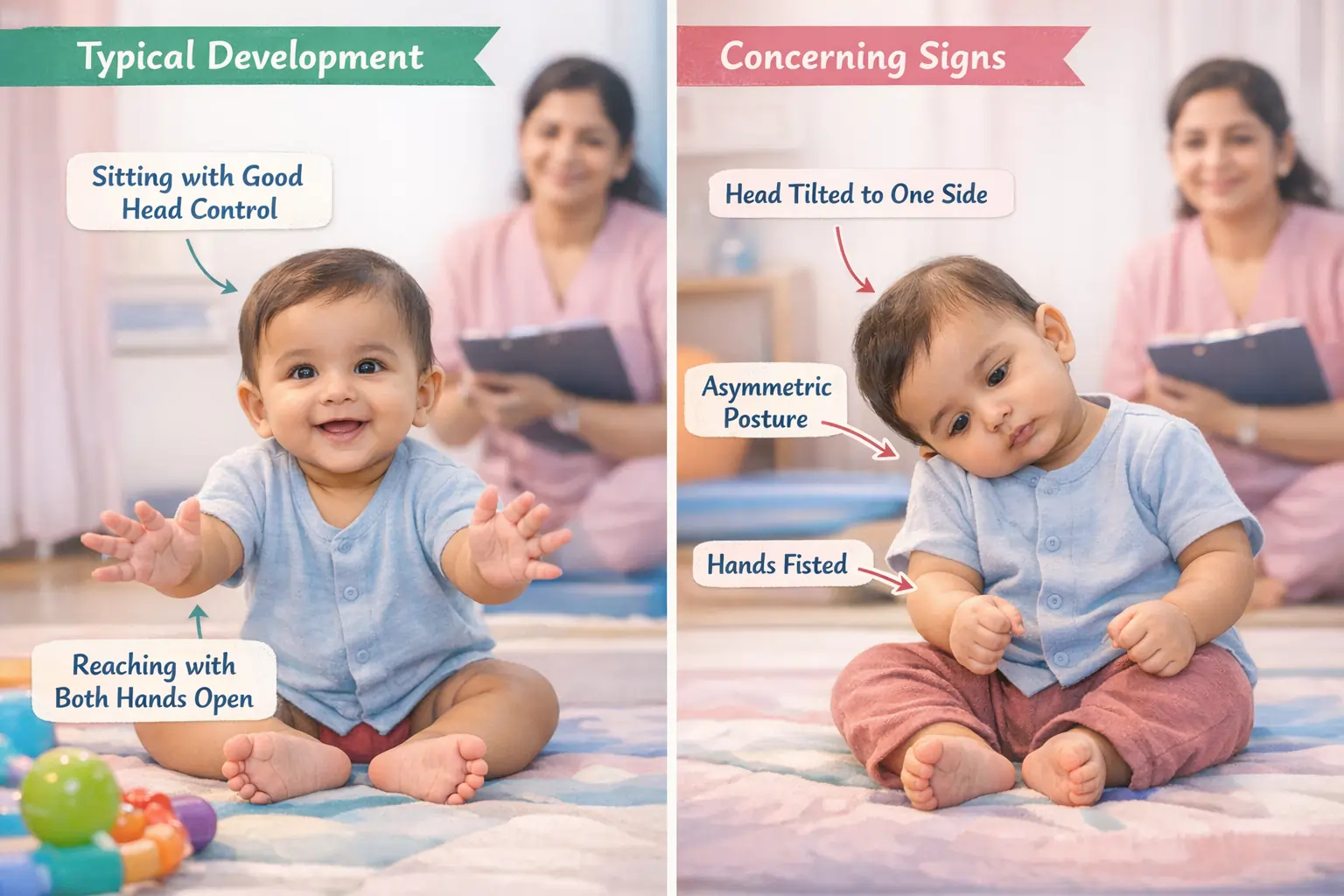
- Hands constantly fisted (not opening)
- Not reaching for objects
- Not bringing hands to midline
- Head lag when pulled to sitting
By 6 Months:
- No head control when sitting
- Not rolling over in either direction
- Hand preference (this is too early and suggests one side is weaker)
- Not bearing weight on legs when supported
By 9 Months:
- Not sitting independently
- Persistent asymmetry (always turning head to one side, using one hand)
- Stiff, scissored leg movements
- Not babbling or making sounds
By 12 Months:
- Not standing with support
- Persistent toe walking
- Not showing interest in objects or people
- Not attempting to communicate
If you notice any of these signs, trust your instincts. Request a developmental screening from your pediatrician. Do not wait for them to bring it up.
The Diagnostic Revolution: Earlier is Better
When Priya was a child in the 1990s, cerebral palsy was often not diagnosed until age two or three. Doctors waited to see if children "caught up." This waiting period was agonizing for families. Worse, it wasted the most critical intervention window.
Today, we can diagnose cerebral palsy with over 90% accuracy before a baby is six months old using a combination of tools:
General Movements Assessment (GMA)
This involves videotaping your baby's spontaneous movements and having a trained assessor analyze them. Babies typically show "fidgety movements" between two and four months. The absence of these movements is a strong predictor of cerebral palsy.
Hammersmith Infant Neurological Examination (HINE)
This standardized neurological exam looks at posture, tone, reflexes, and movement patterns in infants.
MRI Combined with Clinical Assessment
Brain imaging can identify the location and extent of brain injury. Combined with clinical observations, this helps predict the type and severity of cerebral palsy.
Why Early Diagnosis Matters
I know the word "diagnosis" sounds scary. Some parents resist getting their child evaluated because they fear the label. But here is what early diagnosis actually provides:
- Access to services: You cannot get therapy without a diagnosis
- Appropriate interventions: Treatment is tailored to your child's specific type of CP
- Family planning: You can make informed decisions about your family's future
- Optimal timing: You can start intervention during peak neuroplasticity
- Connection to resources: You gain access to support groups, equipment, and funding
- Peace of mind: Uncertainty is often worse than knowing
What Quality Early Intervention Looks Like in Pune
Not all therapy programs are equal. As you search for a Best Neuro Rehabilitation Centre in Pune, here are the qualities that matter most:
Frequency and Intensity
Research is clear on this. More is better. A child who receives therapy five times per week makes significantly more progress than a child who receives therapy once per week.
Look for programs that offer:
- Multiple sessions per week (minimum 3 to 5)
- Parent training so you can continue at home
- Integration of therapeutic activities into daily routines
- Home exercise programs
Family Coaching Component
The therapist should spend significant time teaching you, not just working with your child. You should leave every session with specific activities to practice at home.
Good questions to ask:
- "How will you involve me in therapy sessions?"
- "What should I be doing at home between sessions?"
- "How will you teach me to integrate therapy into daily activities?"
Evidence-Based Practice
Ask what approaches the clinic uses and what research supports those approaches. Be wary of clinics that rely heavily on outdated methods like NDT as their primary intervention.
Look for programs that use:
- Task-oriented functional training
- Goal-directed therapy
- Family-centered care models
- Regular outcome measurements
Advanced Technology
While technology is not necessary for good therapy, it can enhance outcomes. Robotic Neuro Rehabilitation in Pune centers like Apricot Care use advanced equipment that provides:
- Higher intensity practice (more repetitions)
- Precise feedback on movement quality
- Engaging, game-like activities that motivate children
- Objective data on progress
Technology should complement, not replace, hands-on therapy and parent coaching.
Holistic Approach
Quality programs address more than just motor skills. Look for centers that provide or coordinate:
- Nutritional counseling
- Speech and swallow therapy
- Occupational therapy for fine motor and self-care skills
- Psychological support for child and family
- Social work services to connect you with resources
Cultural Sensitivity
In India, family structures and cultural values shape how we approach healthcare. The Best Rehabilitation Centre in Kharadi should understand:
- Joint family dynamics and how to involve multiple caregivers
- Cultural attitudes toward disability
- Financial constraints and insurance navigation
- Language preferences
- Religious and traditional healing practices
Your therapy team should respect your family's values while providing evidence-based care.
Practical Steps You Can Take Today
If you suspect your child has developmental delays or has recently been diagnosed with cerebral palsy, here is your action plan:
Step 1: Get a Comprehensive Evaluation
Request referrals to:
- Pediatric neurologist
- Developmental pediatrician
- Pediatric physiotherapist
- Occupational therapist
Bring videos of your concerns to the appointments. Sometimes children perform differently in clinical settings than at home.
Step 2: Start Intervention Immediately
Do not wait for an official diagnosis. If your child shows delays, early intervention can help regardless of the underlying cause.
Even before you get into a formal therapy program, you can:
- Increase tummy time (work up to 30 minutes daily)
- Practice reaching and grasping during play
- Work on head and trunk control during daily care routines
- Provide opportunities for movement and exploration
Step 3: Educate Yourself
Knowledge is power. Learn about:
- Your child's specific type of cerebral palsy
- Evidence-based interventions
- Your rights under the Rights of Persons with Disabilities Act (2016)
- Available government schemes and support services
Step 4: Connect with Other Families
Other parents who have walked this path are invaluable resources. They can recommend therapists, share what worked for them, and provide emotional support.
Look for:
- Local support groups in Pune
- Online communities
- Parent training workshops
- Family events at therapy centers
Step 5: Take Care of Yourself
You cannot pour from an empty cup. Caring for a child with special needs is demanding. Make sure you:
- Get adequate sleep (ask family for help)
- Maintain your own health appointments
- Take breaks when possible
- Seek counseling if feeling overwhelmed
- Celebrate small victories
The Long-Term Perspective: Hope and Realistic Expectations
Let me be honest with you. Cerebral palsy cannot be cured. The brain damage that causes it is permanent. But here is the amazing part. Function can be dramatically improved.
What Research Shows
Children who receive intensive early intervention before age two show significantly better motor outcomes at age five compared to children who start intervention later. Some achieve near-typical function with the right support.
About 30% of children who show brain scan abnormalities in infancy recover completely with early intervention. Their brains find alternate pathways to accomplish what the damaged areas cannot.
The Two Critical Windows
While earlier is always better, neuroplasticity does not disappear after age three. There is actually a second window of opportunity during puberty when the brain undergoes another period of reorganization.
This means:
- Primary window: Birth to age 4 (exuberant brain growth)
- Secondary window: Puberty (reorganization and refinement)
But neither window can fully compensate for missed opportunities in those crucial first 1000 days.
What Success Looks Like
Success is different for every child. For one family, success might be independent walking. For another, it might be self-feeding with adapted utensils. For another, it might be communicating through assistive technology.
The goal is always the same. Maximize your child's function, independence, participation, and quality of life.
Conclusion: Every Day Matters
Anaya is three years old now. She walks with a walker. She feeds herself with adapted spoons. She attends a mainstream preschool with support. She laughs, plays, and tells her parents elaborate stories about her stuffed animals.
Could she have achieved this without early intervention? Maybe. But Priya does not want to think about that alternative. She remembers those terrifying early months when the future seemed so uncertain. She remembers the first therapy session, the first time Anaya rolled over, the first wobbly steps.
Every single one of those moments was built on the foundation of early intervention during those critical first years.
Here is what I want you to understand. The brain your child has today is the most adaptable it will ever be. Every week that passes without intervention is a week of lost opportunity during peak neuroplasticity. Every inefficient movement pattern they practice becomes more deeply ingrained.
But every therapeutic moment, every "just right challenge," every functional activity you practice together is literally rewiring your child's brain for success.
The work is hard. The journey is long. But the science is clear. Early intervention works. Not because it fixes the brain damage. But because it harnesses your child's incredible capacity to adapt and learn.
What is the one step you will take today to start your child on the path toward their fullest potential? Will you schedule that evaluation you have been putting off? Will you call a cerebral palsy treatment center in Pune to learn about their programs? Will you start practicing tummy time more consistently?
The most important step is the first one. And the best time to take it is right now.
With 6 years of experience, she specializes in neuro-rehabilitation, geriatric care, and balance training to help patients improve mobility and functional independence.
.webp)