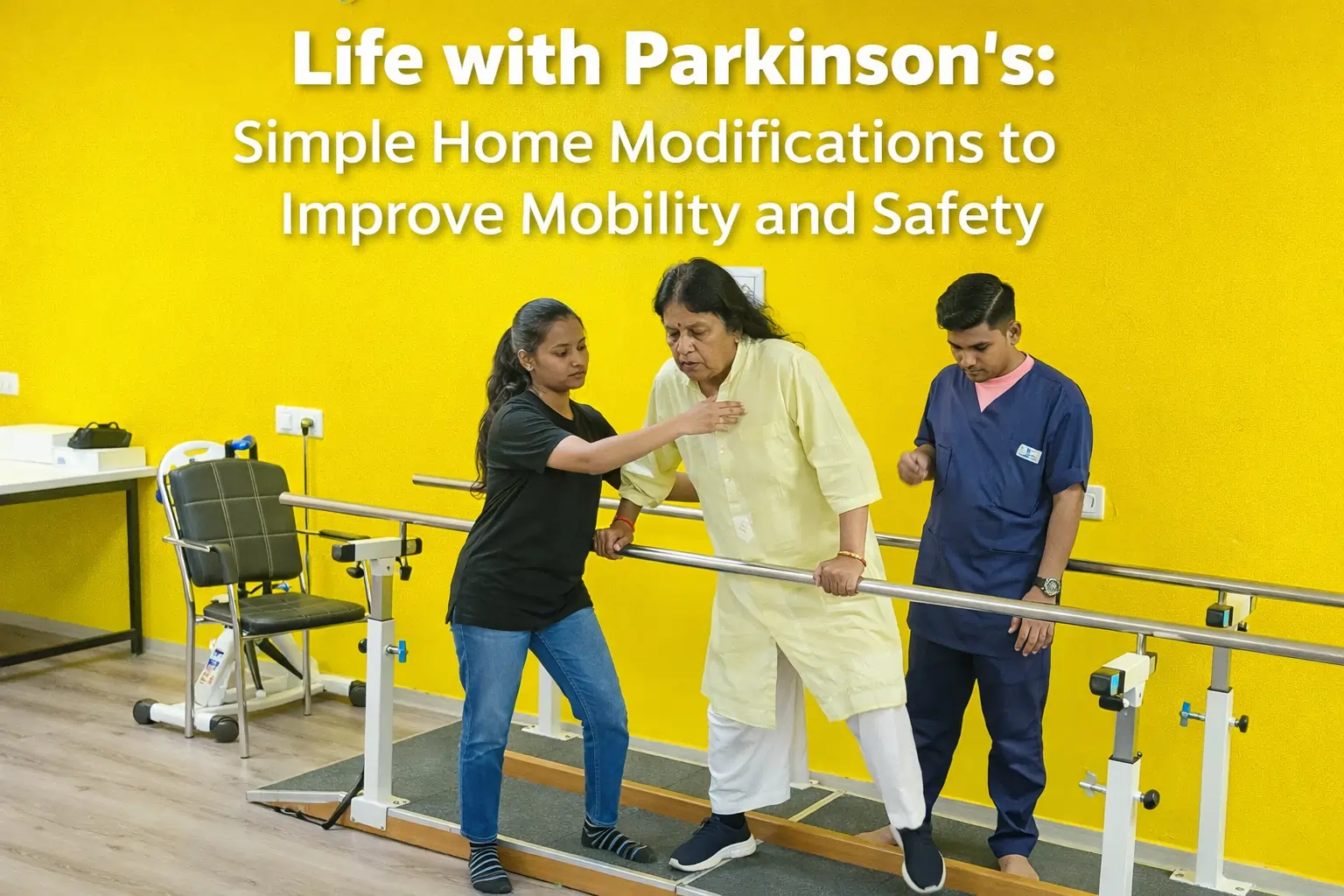
Life with Parkinson's: Simple Home Modifications to Improve Mobility and Safety


Dr. Amol Kathar
MPT (Neuro), 3.5+ years clinical
experience in neurological rehabilitation
Priya sat at her kitchen table, staring at the narrow hallway that led to her bedroom. Three months ago, she wouldn't have given it a second thought. But now, with Parkinson's disease progressing, that hallway felt like it was closing in on her.
She remembered the falling incident last week. A moment of lost balance, a grab for the doorframe that wasn't there, and suddenly she was on the floor. Her daughter had found her crying, not from physical pain, but from the crushing realization that her own home, the place where she'd lived for thirty years, had become a hazard.
What Priya didn't know then was this: her home wasn't her enemy. It just needed to be redesigned. Small, thoughtful changes, changes that nobody had ever explained to her, could give her back the independence and confidence she thought she'd lost forever.
If you or a loved one has recently received a Parkinson's diagnosis, this story probably resonates. You might be wondering how to stay safe at home without feeling trapped or dependent. The good news? The answer isn't expensive renovation or accepting your limitations. It's understanding how Parkinson's changes the way your body moves and then adapting your space accordingly.
What are home modifications for Parkinson's patients? They are strategic changes, from doorway widths to floor colors to smart technology, designed to prevent falls, reduce freezing episodes, and restore independence in daily living.
Why Parkinson's Makes Your Home Hazardous
What Happens to Movement When You Have Parkinson's Disease
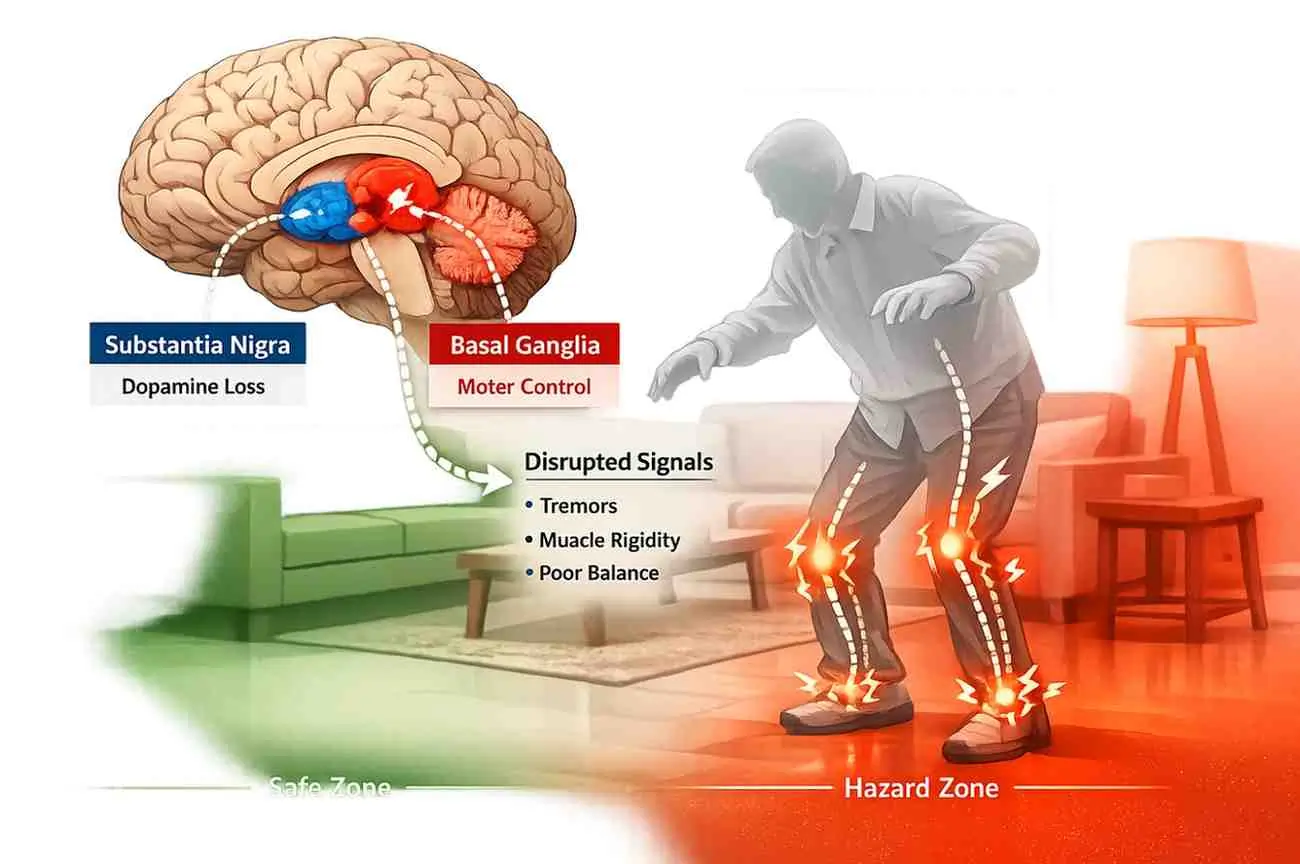
Parkinson's doesn't just affect how fast you move. It changes the brain's ability to coordinate movement in three critical ways that most home safety guides completely overlook.
First, your body struggles with balance and postural instability. You might feel like you're falling forward even when standing still. Your feet shuffle instead of lifting fully. The neurological signals that keep your spine straight and your balance steady get disrupted. This isn't weakness. Your muscles work fine. Your nervous system is sending confused messages.
Second, tremors and muscle rigidity kick in. Your hands shake. Your limbs feel stiff and resistant to movement. Simple tasks like turning doorknobs or gripping railings become harder. A light doorknob suddenly requires concentration. Holding a railing requires strength you didn't know you'd lost.
Third, and what most people never mention, your brain loses touch with where your body is in space. This is called proprioception. You can't naturally sense whether your foot is on flat ground or about to hit a step. Your eyes have to compensate, which means your brain works overtime just to walk. This is critical information for home design. Your eyes are now your primary balance tool, not your inner ear.
The Hidden Dangers Most People Miss
Here's what doctors often skip over: Parkinson's affects your vision processing, not just your muscles. Your eyes take in information, but your brain struggles to interpret it quickly. Busy patterns confuse you. Shadows look like obstacles. Reflective surfaces create visual chaos. Your visual processing system is working harder than ever before.
Add in that 19 to 49 percent of older adults fall each year, but that number nearly doubles for people with Parkinson's disease. And these aren't small stumbles. Falls lead to broken hips, hospitalizations, lost independence, and the psychological trauma of fearing your own home.
Your home was designed for a body that works differently than yours does now. The tight hallway, the glossy floor, the small doorframes, none of these were problems before. Now they're hazards. But here's the encouraging truth: understanding why these spaces became dangerous means you can fix them. And the fixes are often simple.
Freezing of Gait, The Symptom Nobody Explains
What It Feels Like When Your Feet Won't Move
Imagine walking down your hallway, and suddenly your feet feel glued to the floor. You want to move forward. Your brain sends the signal. But your legs don't respond. You're frozen in place for five, ten, sometimes thirty seconds. Then, as mysteriously as it started, movement returns.
This is freezing of gait (FOG). It happens in 20 to 60 percent of people with Parkinson's, especially in later stages. And here's the shocking part: your home layout directly triggers it.
The Doorway Problem That Most Articles Miss
Most blogs about home safety mention doorways once in passing. They should mention them a hundred times.
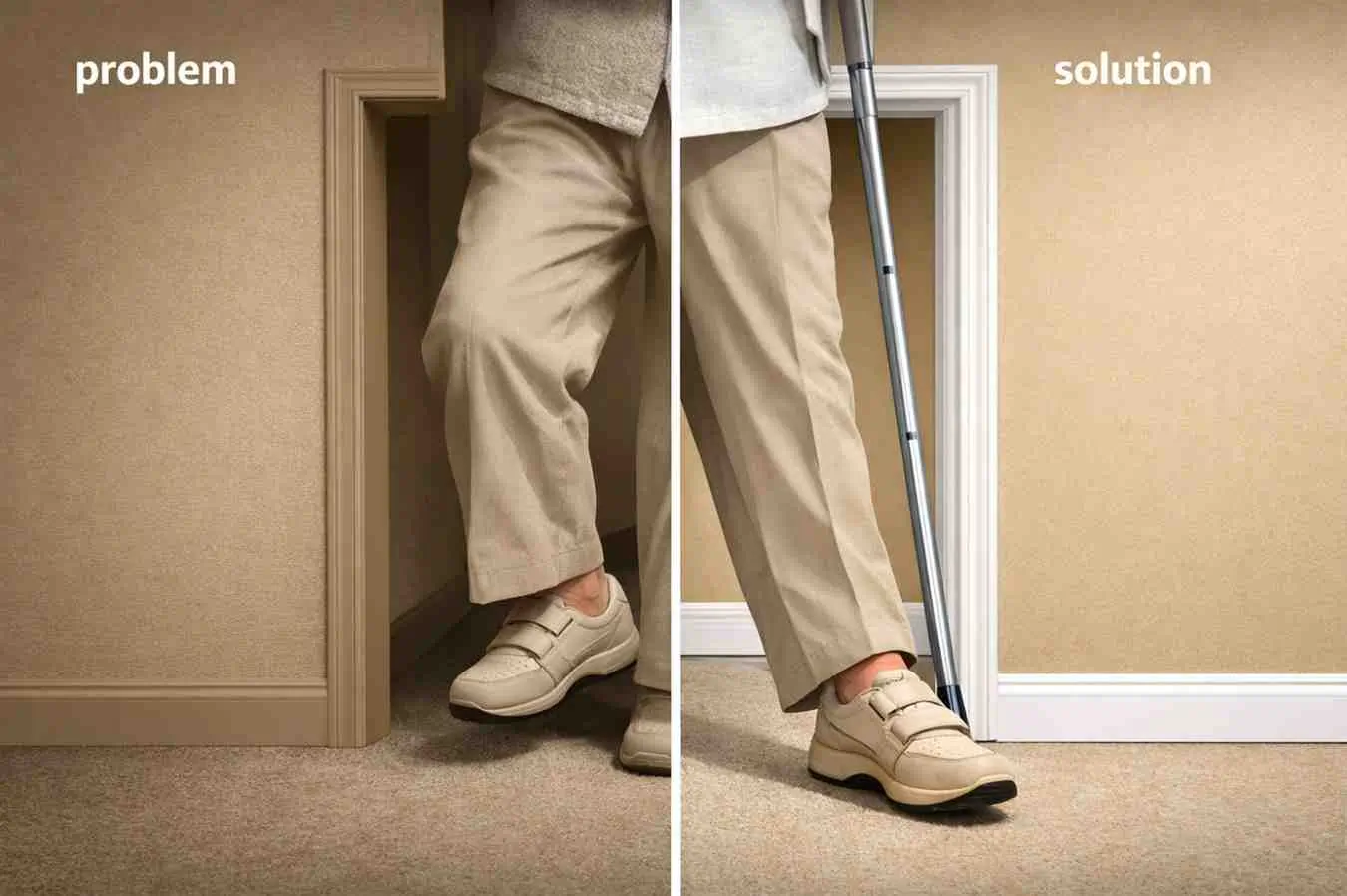
Small, low doorways trigger freezing disproportionately. When your brain perceives a tight space, it sends conflicting signals about whether you can fit through. Your feet freeze. Your confidence shatters.
But the real game-changer? The color of your doorframe matters. When your doorframe is the same color as the wall surrounding it, your brain struggles to recognize the doorway as a distinct space. This creates visual confusion that actually increases freezing episodes.
Paint your doorframe a contrasting color, white frame on beige wall, dark frame on light wall, and something remarkable happens. Your brain processes the space better. Freezing decreases. This is a ₹400 fix that nobody talks about.
Here's what you need to do:
- Doorways should be minimum 32 inches wide (wider is better)
- Ensure 5-6 feet of open space before and after doorways
- Paint doorframes in high contrast to surrounding walls (₹400-800)
- Consider automatic door-opening mechanisms (₹8,000-15,000)
Visual Floor Design, Helping Your Brain Move Better
Why You Need More Visual Guidance, Not Less
This contradicts everything people think about home design. People assume that cluttered, busy environments are bad for people with Parkinson's. That's partially true. But here's the truth most guides miss: you actually need strategic visual cues to move safely.
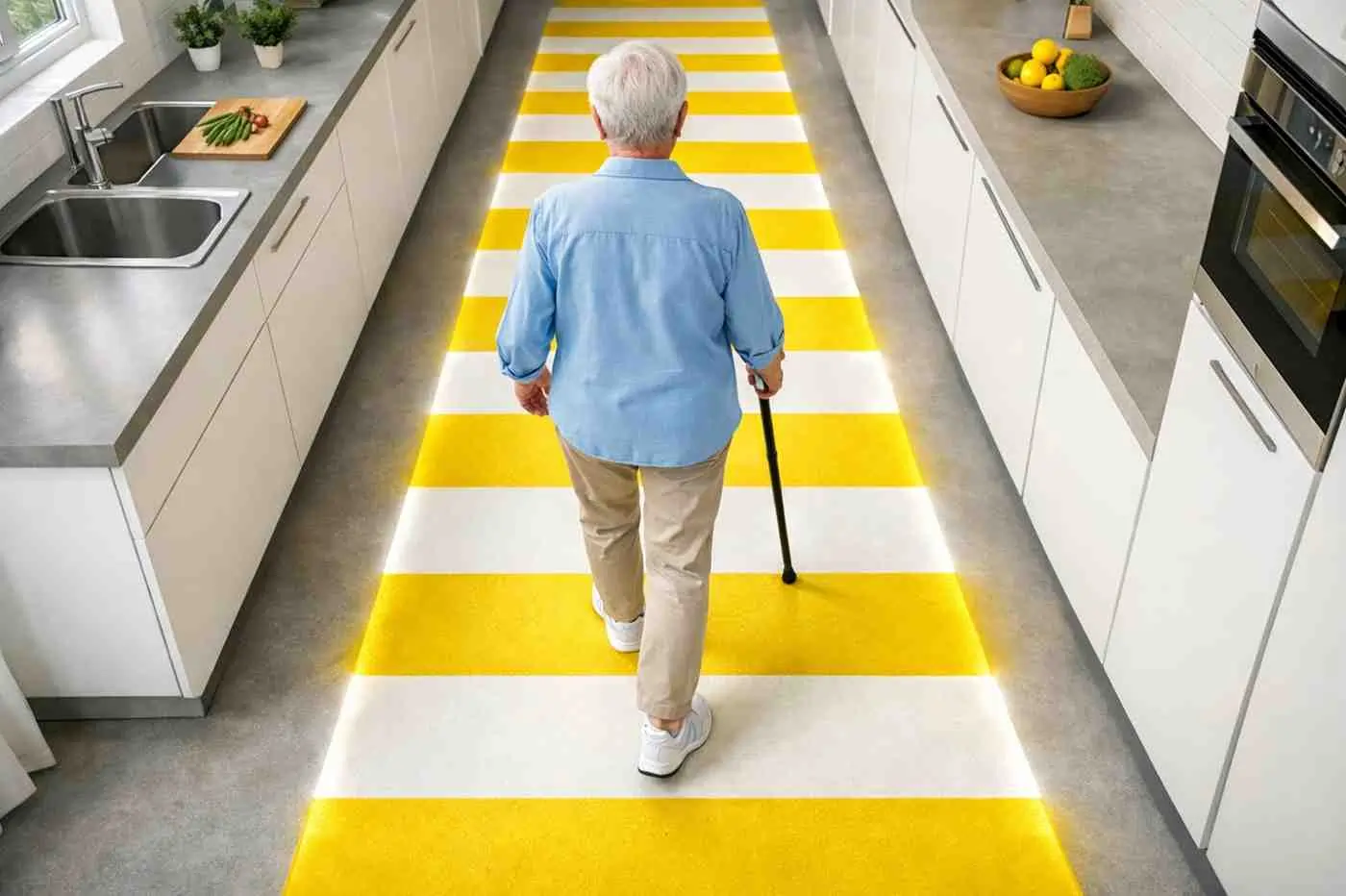
Because proprioception is damaged, your brain relies more on your eyes for balance and movement initiation. High-contrast markings on your floor act like targets your brain can lock onto. They help you regulate stride length. They give your movement a visual anchor.
Matte finish flooring, not glossy, matters because reflective surfaces create glare that overwhelms your visual processing system. Your brain gets confused by shiny surfaces. Matte finishes provide consistent, predictable visual information.
How to Create Visual Cues That Work
Floor pattern modifications: Paint or tape high-contrast stripes on your kitchen floor, hallway, and bedroom (₹800-1,500 paint). The pattern mimics a "miniature crosswalk" effect that helps your brain coordinate stepping rhythm. Yellow and white stripes, or dark and light combinations, both work.
Step edge marking: If you have stairs, paint the edge of each step in a contrasting color (₹300-600).
Flooring material selection: Choose textured vinyl, rubber, or non-slip tiles (₹80-150/sq.ft.). Avoid shiny porcelain or polished wood. Low-pile carpet works if it has grip.
Surface transitions: Never create abrupt changes between carpet and tile. If you must have different flooring types, mark the transition visually and make it gradual if possible.
Bathroom Safety: Going Beyond Standard Grab Bars
Placement and Installation Matters More Than You Think
Everyone knows grab bars help. But here's what they don't tell you: placement matters profoundly.
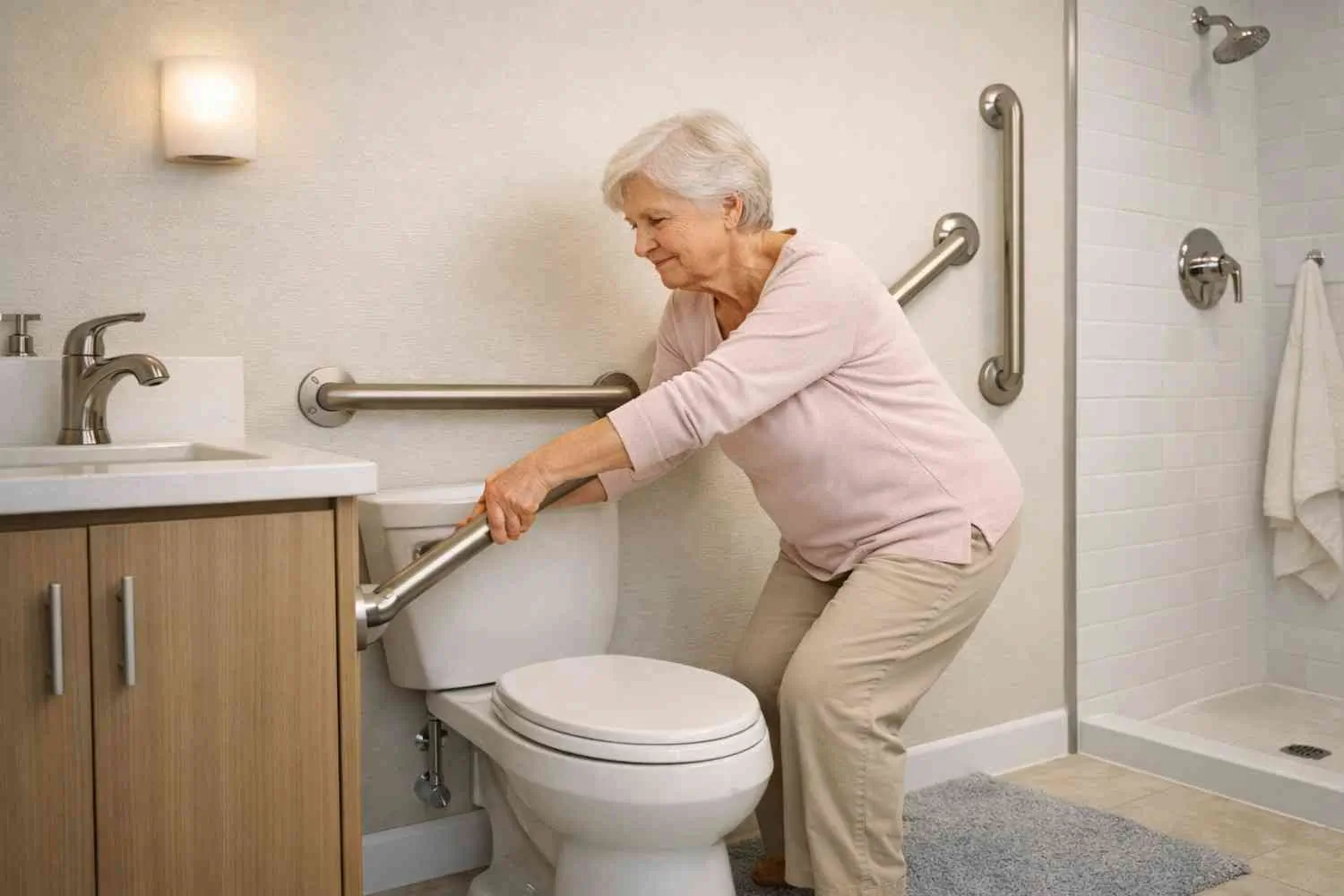
Install grab bars 24 to 30 inches from the floor (₹1,200-3,000 per bar). This is the natural grip height for sitting and standing. Don't rely on a single horizontal bar. Install both horizontal and vertical bars. The diagonal gripping pattern helps your body during the precarious sit-to-stand transfer, where freezing often happens.
Lever faucets instead of knobs: Hand tremors make turning knobs dangerous and frustrating. Lever handles require 80 percent less fine motor control (₹2,000-5,000). Anti-scald devices should accompany any faucet (₹800-1,500).
Motion-sensor lighting: This is the hidden game-changer. Nighttime bathroom trips are when falls most commonly happen. Motion sensors activate lights automatically as you approach (₹1,500-4,000). No switch to fumble for. No darkness to navigate.
Advanced Bathroom Strategies
Non-slip mats seem obvious, but the details matter. Choose mats with antimicrobial backing (₹500-1,200). Make sure the mat itself doesn't shift when you step on it. Secure corners if necessary.
A shower chair isn't just for mobility-limited individuals. It reduces fatigue and tremor-related falls (₹2,500-6,000). Some people with Parkinson's have surprising improvements in tremor severity when seated. The proprioceptive feedback from contact with the chair actually helps.
Kitchen Modifications: Seated Independence Works Better
How Sitting Actually Reduces Tremors
Standing at a kitchen counter with tremors means spilling, dropping, and frustration. Here's the overlooked truth: tremors reduce significantly when you sit. The seated position provides proprioceptive feedback that your brain uses to stabilize movement.
Install a bar stool at counter height (₹3,000-8,000). This isn't about weakness or disability. It's about adapting your workspace to how your nervous system currently functions. And it preserves dignity. You're still preparing your own meals. You're still independent.
Smart Kitchen Layout and Storage
Store frequently-used items at waist-to-eye height. Avoid high shelves. Reaching overhead increases fall risk. Reaching low requires bending, which destabilizes balance.
Pull-out shelves and lazy susans reduce the need to reach deep into cabinets (₹2,500-7,000). Label your drawers and cabinets clearly. Cognitive decline sometimes accompanies Parkinson's, and visual labels help your brain retrieve memories faster.
One-handed appliances (electric can openers, ₹1,500-3,500) accommodate tremor. Lightweight pots and pans reduce injury severity if dropped. Anti-scald features on kettles and coffee makers prevent burns (₹1,200-2,500).
Bedroom and Nighttime Safety: The Most Vulnerable Hours
Motion-Sensor Lighting Changes Everything
The bedroom is where many Parkinson's patients feel most vulnerable. The transition from sleep to walking to the bathroom is hazardous. Your balance is worse. Your brain is groggy. Darkness increases your reliance on proprioception, which is already damaged.
Motion sensors under the nightstand or above the doorway activate lights automatically (₹1,500-4,000). You don't need to find a switch. You don't need to fumble with a flashlight. Light appears as you move. This simple change makes people dramatically more willing to move independently at night.
Transfer Assistance and Optimal Bed Height
A floor-to-ceiling transfer pole (installed near the bed) provides stability (₹4,000-8,000). Bed height matters. 18 to 20 inches is optimal. Too low and standing becomes nearly impossible. Too high and sitting down is awkward.
Half-side rails (not full rails, which restrict movement) assist without creating a sense of being "caged in" (₹3,500-7,000). A bedside commode reduces nighttime bathroom trips, a major fall risk factor (₹3,000-6,500).
The Technology Most Articles Ignore Completely
Wearable Fall Detection: Real Technology, Real Results
This isn't futuristic. It's available right now. A necklace-worn fall detection device contains an accelerometer and barometer (₹2,000-4,000 upfront + ₹2,000-4,000/month). When it detects a change in elevation (falling) and impact patterns, it automatically alerts an emergency response center. Real medical personnel contact you. If you don't respond, they dispatch help.
The accuracy? Over 95 percent. The peace of mind? Invaluable.
Real-world data from 2,063 Parkinson's patients showed 73.5 percent automatic detection rates. People weren't able to push a button after falling, but the device detected the fall anyway. This technology removes the burden of manual reporting.
Vibrating Socks for Freezing Episodes
Emerging research shows vibrating socks reduce freezing episodes by more than 50 percent (₹25,000-40,000). How? Rhythmic vibration to your feet provides external cues that bypass the damaged basal ganglia circuits in your brain. It's worn under your clothing (socially acceptable), and works specifically on the freezing problem that grab bars and doorways alone can't solve.
Smart Home Devices as Safety Tools
Voice-activated lighting (Amazon Alexa, Google Home) means hands-free light control (₹3,500-7,000). No switch to locate. Smart thermostats eliminate standing to adjust temperature (₹5,000-10,000). Ring doorbells let you answer without getting up (₹4,000-8,000).
These devices seem like luxuries. They're actually safety essentials.
Furniture and General Layout: Design for Your Nervous System
Why Soft Edges Matter More Than You Think
This seems trivial until you experience it. Soft, rounded furniture edges reduce both the injury severity from falls and the anxiety associated with moving through your space. Sharp corners feel threatening. Your body tenses. Tension increases freezing.
Choose firm chairs with good armrests (₹4,000-10,000). Avoid low-slung furniture that requires extreme hip and knee bending to stand from. Avoid heavy furniture with unstable bases that might wobble if you grab for balance.
Walkway Width and Psychological Safety
Minimum three feet for safe passage. Five and a half feet if using a walker. But wider is always better. It provides a buffer zone for when balance is uncertain. Wide hallways reduce the psychological pressure that triggers freezing.
Neutral tones (gray, beige, soft white) create calmer environments than chaotic color schemes. Soft lines and flowing layouts feel less intimidating than sharp angles and cluttered arrangements. This isn't interior design preference. It's neurology. Calmer visual environments reduce freezing episodes.
Making Modifications Affordable: A Phased Approach (INR Pricing)
Phase 1: Free and Low-Cost (₹0 to ₹4,000)
Start here. Remove throw rugs immediately. Clear clutter from all walkways. Secure electrical cords to walls with tape. Install ₹400-1,200 nightlights. Paint contrast stripes on floors using ₹800-1,500 paint. Use painter's tape (₹400) to trial visual cues before permanent installation.
This phase costs almost nothing and prevents the majority of falls.
Phase 2: Moderate Investment (₹40,000 to ₹1,60,000)
Install grab bars in bathroom and bedroom (₹12,000-24,000). Add motion-sensor lighting (₹8,000-24,000). Install handrails on stairs (₹16,000-32,000). Upgrade to lever-style faucets (₹4,000-12,000). Add non-slip mats and flooring in high-risk areas (₹40,000-1,20,000).
Phase 3: High-Impact, Higher-Cost (₹1,60,000 and Up)
Full bathroom renovation (₹2,00,000-5,00,000). Complete flooring replacement (₹1,50,000-4,00,000). Door installation (₹25,000-60,000). Stair lifts or bedroom relocation (₹3,00,000-8,00,000). Technology integration (smart home system ₹80,000-2,40,000). Wearable fall detection (₹24,000-40,000 upfront).
The key: Test with temporary solutions first. Use painter's tape, removable mats, and clamp-on bars before committing to permanent changes.
When to Consult an Occupational Therapist
An occupational therapist assessment (₹16,000-40,000, often covered by insurance) identifies fall hazards specific to your symptoms and prioritizes modifications for maximum impact. Not all recommendations apply to everyone. Your freezing of gait might be severe while balance is stable. Your tremors might be significant while mobility is strong. An OT personalizes the approach.
Ask your neurologist for a referral, or contact your state's disability agency for OT recommendations.
The Role of Specialized Neuro Rehabilitation
If you're navigating Parkinson's recovery or managing symptoms long-term, a neuro rehabilitation centre in Pune plays an essential role alongside home modifications. Occupational therapists at specialized facilities understand not just how to modify homes, but why specific changes matter for Parkinson's neurology.
Apricot Care Assisted Living and Rehabilitation combines physical therapy, occupational therapy, and neurological expertise to address both movement challenges and home accessibility needs. Here's what this means for you: a professional assessment identifies which modifications matter most for your specific symptom profile. Not everyone needs vibrating socks. Not everyone struggles with the same freezing triggers. Personalization is key.
Robotic neuro rehabilitation in Pune offers advanced equipment that helps retrain motor patterns. Physical recovery that complements the home environment work. When you practice improved movement patterns in a rehabilitation setting, the home modifications you've made support that practice. The two work together.
If you've experienced a stroke, you know how critical stroke treatment, rehabilitation and physiotherapy services become in recovery. A best rehabilitation centre in Kharadi or similar facility can assess your specific home needs as part of your overall recovery plan. The same applies to Parkinson's management. Stroke care rehab in Pune, brain injury recovery in Pune, spine care rehabilitation, and respiratory therapy in Pune all benefit from homes designed for neurological conditions.
The point is this: home modifications work best when paired with professional assessment and ongoing support. You don't have to figure this out alone.
Creating Your Home Modification Plan: Five Steps
Before you start painting doorframes and buying grab bars, make a plan. Here's how:
Step One: Walk through your home as if experiencing it for the first time with Parkinson's symptoms. Which doorways feel narrow? Which hallways feel dark? Which transitions feel disorienting? Note these problem areas.
Step Two: Start with Phase 1 (free modifications). Removing throw rugs takes an afternoon. It prevents falls immediately.
Step Three: Assess your specific symptoms. Do you experience freezing? Prioritize doorway design. Significant tremor? Focus on kitchen modifications. Nighttime balance issues? Motion-sensor lighting is your first investment.
Step Four: Consult an occupational therapist if possible. They identify hazards you might miss. They recommend specific products tailored to your home's layout.
Step Five: Test before committing. Use painter's tape for floor stripes. Use removable shower grips. Try a bedside commode before plumbing changes. Make sure modifications actually help before making them permanent.
Conclusion: Your Home Can Support You
Priya's story isn't unique. Thousands of people receive Parkinson's diagnoses and feel their independence slipping away. But here's what Priya learned: her home wasn't her enemy. It just needed translation. It needed to speak the language of a nervous system that processes differently.
Small changes, contrast-painted doorframes (₹400), motion-sensor lights (₹1,500), visual floor cues (₹800), appropriate grab bar placement (₹1,200), fundamentally altered her relationship with her own space. Within two weeks, she felt more stable. Within a month, she was moving independently again. Not despite Parkinson's, but by working with how her neurological system actually functioned.
She discovered that a ₹1,600 can of paint was more effective than expensive equipment. That painter's tape could trial modifications before permanent investment. That understanding why a modification matters made her more willing to implement it.
The modifications cost less than she expected. The impact exceeded everything she hoped.
Here's what you can do today: Which room in your home makes you most anxious? Start there. Remove clutter. Install a ₹400 nightlight. Trial a visual floor stripe with painter's tape. One room. One change. Then build from there.
Your home doesn't have to trap you. It can support you. And the transformation starts with understanding that Parkinson's changes how you move, not how determined you are to keep moving.
Ready to Transform Your Home?
If you're ready to create a safer, more independent home environment while also addressing the underlying movement challenges of Parkinson's or other neurological conditions, Apricot Care Assisted Living and Rehabilitation (a leading neuro rehabilitation centre in Pune) offers comprehensive services. Our team combines occupational therapy, physical therapy, and advanced rehabilitation techniques including robotic neuro rehabilitation in Pune to support both home safety and symptom management.
Whether you need a professional OT assessment for home modifications, ongoing rehabilitation support for stroke treatment and physiotherapy services, brain injury recovery, spine care rehabilitation, or respiratory therapy, we provide personalized care at our best physiotherapy centre in Pune and rehabilitation locations across Kharadi and beyond.
Ready to take the next step? Schedule a consultation with our rehabilitation specialists. Let's design a home and treatment plan that works for your life.
With 3.5 years of experience, he specializes in personalized rehabilitation for stroke, spinal cord injuries, and mobility training to help patients regain independence.
.webp)