
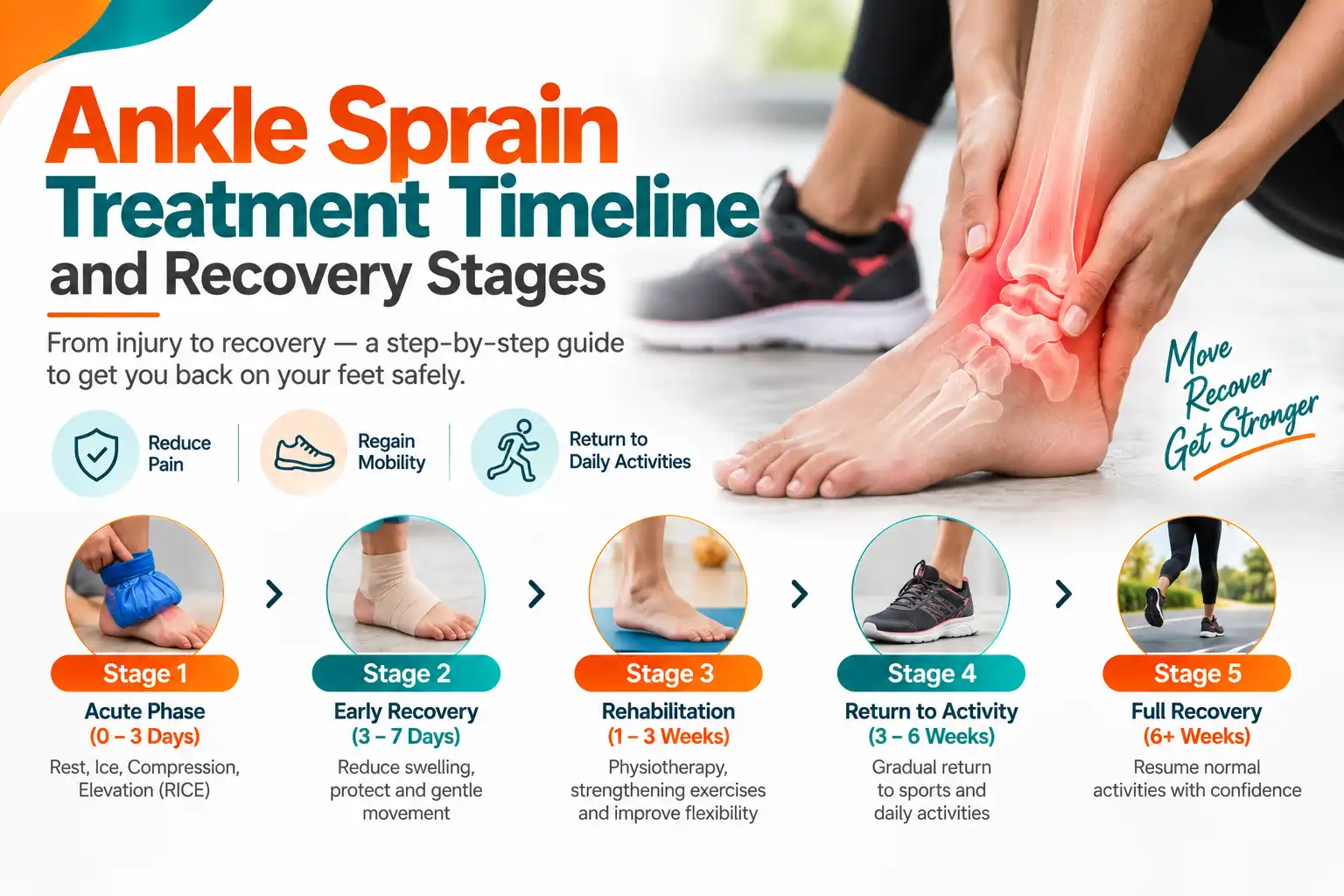

You rolled your ankle, and the swelling has started. Should you rest, walk, exercise, or wait? An ankle sprain treatment timeline can help you understand the usual stages, but it cannot tell you exactly when your ankle is healed. A mild ligament injury and a severe tear do not follow the same schedule. This guide explains what to do in the first days, how physiotherapy progresses, and which warning signs need medical assessment. The goal is a safe return to normal walking and activity, not simply a pain-free ankle at rest.
What Happens When You Sprain Your Ankle
A sprain injures one or more ligaments, the strong bands that help stabilise the ankle. It often happens when the foot rolls inward during a misstep, run or landing. Pain, swelling and bruising can follow quickly, while stiffness and a limp may become more obvious later. A twist can also injure bone, cartilage or tendons. That is why severe pain or an inability to bear weight should not automatically be labelled a simple sprain.
Clinicians sometimes describe sprains as mild, moderate or severe, based on ligament damage and joint stability. Those labels are useful, but they are not a promise that someone will recover in a set number of days. Previous sprains, high-ankle injuries, associated fractures, health conditions and the demands of your sport can all alter the course.
Ankle Sprain Treatment Timeline by Recovery Stage
Use the stages below as a guide to what recovery may involve. The days and weeks overlap, and your symptoms and clinical assessment matter more than a rigid calendar. If a doctor has diagnosed a fracture, prescribed a boot or given weight-bearing restrictions, follow those instructions instead of this general timeline.
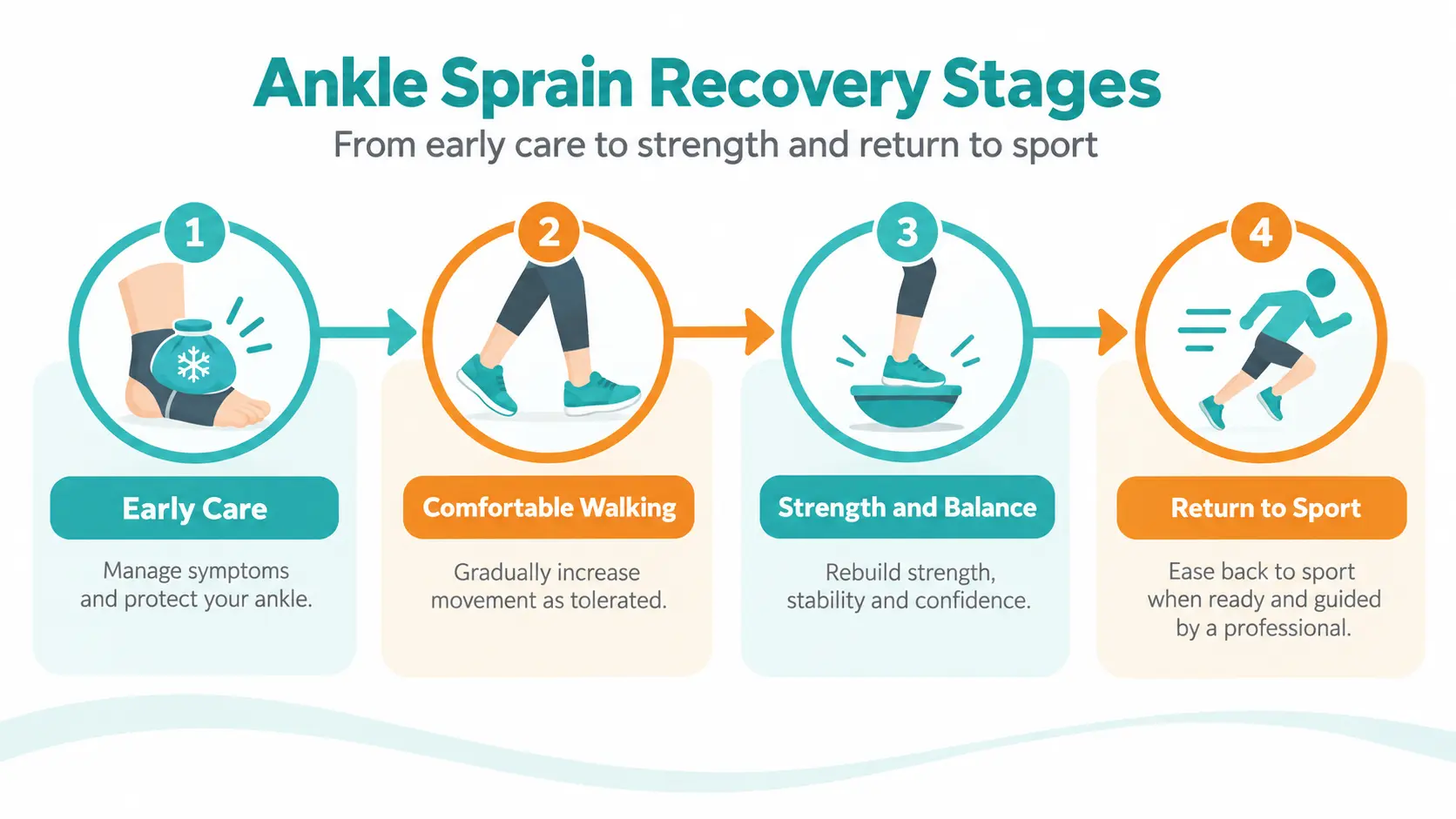
First 24 to 72 Hours Protect the Ankle and Check for Serious Injury
Stop running or playing and assess whether you can safely stand. Reduce activities that sharply increase pain, but avoid unnecessary complete bed rest. Elevation can help with swelling. A cold pack wrapped in cloth may ease pain; keep it off bare skin. If you use compression or a brace, it should feel supportive rather than tight or numb. Ask a clinician or pharmacist before using pain medication, especially if you are pregnant, have kidney disease, stomach ulcers or take blood-thinning medicines.
When a serious injury has been excluded, small, comfortable ankle movements and short walks may be appropriate as tolerated. Do not force movement through sharp pain. If you cannot take four steps, have tenderness directly over ankle bones, marked deformity, numbness or a cold or pale foot, seek prompt medical assessment. An X-ray may be needed to exclude fracture.
Days 3 to 7 Restore Comfortable Movement and Walking
As pain and heat settle, start gently moving the ankle up and down and, if comfortable, through small circles. Walk short distances with the most normal pattern you can manage. Supportive shoes and a clinician-advised brace or walking aid can help if you are limping. Increase walking gradually; a clear increase in pain or swelling later that day or the next morning means you may have done too much.
If the ankle is not improving, you still cannot put weight through it after several days, or pain is becoming worse rather than better, arrange a clinical review. A slow start can be normal after a substantial sprain, but ongoing inability to bear weight should not be ignored.
Weeks 1 to 3 Build Strength and Balance
Once walking is easier, rehabilitation usually adds calf raises, controlled ankle resistance and supported single-leg balance. A physiotherapist may also check how far your knee can move forward over your foot, how your calf and hip muscles work, and whether you compensate when using stairs. Exercises should be progressed according to symptoms and control, not copied from a generic video in one session.
Swelling can remain noticeable even as pain improves. Your ankle may feel unsteady on uneven ground because strength and balance have not yet recovered. This is a reason to keep rehabilitating, not a reason to test it with a full game or a long run.
Later Weeks Return to Running and Sport Specific Tasks
When you can walk briskly without a limp or a significant symptom flare, the next steps may include more demanding strength work, longer single-leg balance, then a gradual walk-jog programme. Jogging on level ground usually comes before sprints, hopping, landing and direction changes. Sports such as football or badminton require more than straight-line running: cutting, pivoting and confidence under fatigue also matter.
Many ankle sprains improve over weeks, while a more significant sprain may take around 8 to 12 weeks or longer to recover fully. High-ankle sprains and other associated injuries can take longer. If you have not regained function as expected, reassessment matters more than waiting for a calendar milestone.
What Helps an Ankle Sprain Heal Well
The most useful plan changes with the stage of healing. Early on, protect the injury and keep movement comfortable. Later, rebuild what the injury took away: ankle motion, calf strength, balance, walking tolerance and the ability to manage sudden changes of direction. Skipping straight from rest to sport can leave these gaps hidden.
A typical exercise progression may start with ankle pumps and gentle circles, move to supported heel raises and light resistance, then include single-leg balance and activity-specific drills. These are examples, not a prescription. Stop or scale back if a movement produces sharp pain, increased swelling or a worse limp. After a severe injury, do not begin resistance or balance drills until medically cleared.
If you are unsure which stage fits your injury, read about ankle pain physiotherapy in Pune and consider an assessment before advancing exercises.
When Do You Need Medical Assessment
Seek urgent care after an ankle injury if the joint looks deformed, the foot is cold or pale, you have new numbness, an open wound or you cannot take four steps. Marked tenderness on the ankle bones also needs prompt assessment. A clinician can decide whether imaging is appropriate; a visible bruise alone cannot distinguish sprain from fracture.
Arrange a review if pain and swelling are worsening, if you still cannot bear weight after several days, or if the ankle repeatedly gives way. Persistent pain on the inner ankle, above the joint or at the base of the foot can point to a different injury pattern. Fever with a hot, red joint is another reason for prompt medical care. Do not rely on exercise advice to manage these signs.
How Physiotherapy Supports Recovery
Physiotherapy begins with an assessment of the injury story, swelling, tenderness, walking and ankle movement. The clinician checks whether a medical referral is needed before prescribing exercise. When rehabilitation is suitable, the plan may combine education about safe loading, mobility work, progressive calf and ankle strengthening, balance training and a staged return to work or sport.
For a runner, the plan may track walking tolerance before jogging. For someone whose work involves prolonged standing, the focus may be shift length, footwear and stair confidence. For a footballer, the later programme needs hops, changes of direction and full training tasks. The exercises change because the destination changes.
For athletes, sports injury physiotherapy may help plan the later return-to-play stages.
Can You Return to Sport When the Pain Is Gone
Not necessarily. Pain at rest may settle before ankle strength, balance and confidence return. A better question is whether you can complete the movements your sport requires during and after a session without a meaningful flare. This may include brisk walking, calf raises, controlled single-leg balance, hopping, landing and direction changes, depending on the sport and the injury.
A clinician can compare the injured side with the other side and check your response over the following day. Bracing or taping may be considered in some circumstances, but it does not replace rehabilitation. If the ankle keeps giving way, do not simply push through: recurrent instability deserves assessment.
Common Recovery Mistakes to Avoid
Doing too much on the first good day is common. Swelling can lag behind activity, so judge progress by how the ankle feels later and the next morning. Another mistake is stopping exercises when walking first becomes comfortable. You may still need strength and balance work to return to running or uneven ground. Finally, do not assume every twisted ankle is a sprain: a fracture or another injury needs a different plan.
Final Words
An ankle sprain treatment timeline is a sequence of milestones, not a fixed deadline. Start with safety and symptom control, restore comfortable walking, then build strength and balance before testing running or sport. If you cannot bear weight, have bony tenderness or are not improving as expected, seek medical assessment. If you need help choosing the right exercises or returning to activity, an individual physiotherapy plan can make the next step clearer.
Need an ankle assessment in Pune? Explore Apricot Care ankle pain physiotherapy or contact the clinic. You can also call +91 73876 41462 to ask about an appointment.
Frequently Asked Questions
How long does a sprained ankle take to heal?
A mild sprain may improve over several weeks, but a more significant sprain can take 8 to 12 weeks or longer to recover fully. The timeline depends on injury severity, other damaged structures and the demands of your work or sport. Improvement in pain does not always mean strength and balance have returned.
Can I walk on a sprained ankle?
After a fracture or serious injury has been ruled out, short, comfortable walks are often encouraged as symptoms allow. Use support if advised, avoid limping through severe pain, and reduce the distance if swelling or pain increases afterward.
When should ankle sprain exercises begin?
Gentle ankle movement can often begin early, as tolerated, once a clinician has ruled out a fracture or other serious injury. Strengthening and balance work usually follow when walking and weight bearing become more comfortable. The exact progression should match your injury.
How do I know if my ankle sprain needs an X-ray?
Seek prompt medical assessment if you cannot take four steps, have marked tenderness over ankle bones, visible deformity or severe symptoms after injury. A clinician can apply a validated decision rule and decide whether imaging is needed; do not use a blog to rule out a fracture.
When can I return to running or sport after an ankle sprain?
Return when walking, ankle movement, strength and balance have recovered enough for the demands of your sport. Progress from straight-line jogging to faster running, hopping and direction changes without a significant symptom flare. A physiotherapist can assess readiness; a calendar date alone is not enough.
Can Apricot Care help with ankle sprain rehabilitation in Pune?
Apricot Care offers ankle pain physiotherapy assessment in Kharadi, Pune. The team can assess movement, strength, balance and walking, then plan stage-appropriate rehabilitation. If a fracture or another serious injury is suspected, medical assessment should come first.
References
- Cambridge University Hospitals ankle injury and recovery guidance
- North Bristol NHS Trust ankle injury rehabilitation guidance
- American College of Radiology acute ankle trauma imaging guidance
- Return to sport after lateral ankle sprain consensus framework
Image disclosure: All images in this article are AI-generated for illustration only.
Medical Note: This article is general health information, not a diagnosis or individual treatment plan. Seek prompt medical assessment for suspected fracture, severe symptoms or a cold, pale or numb foot. Follow your treating clinician's advice if you have a fracture, surgery or weight-bearing restrictions.
.webp)