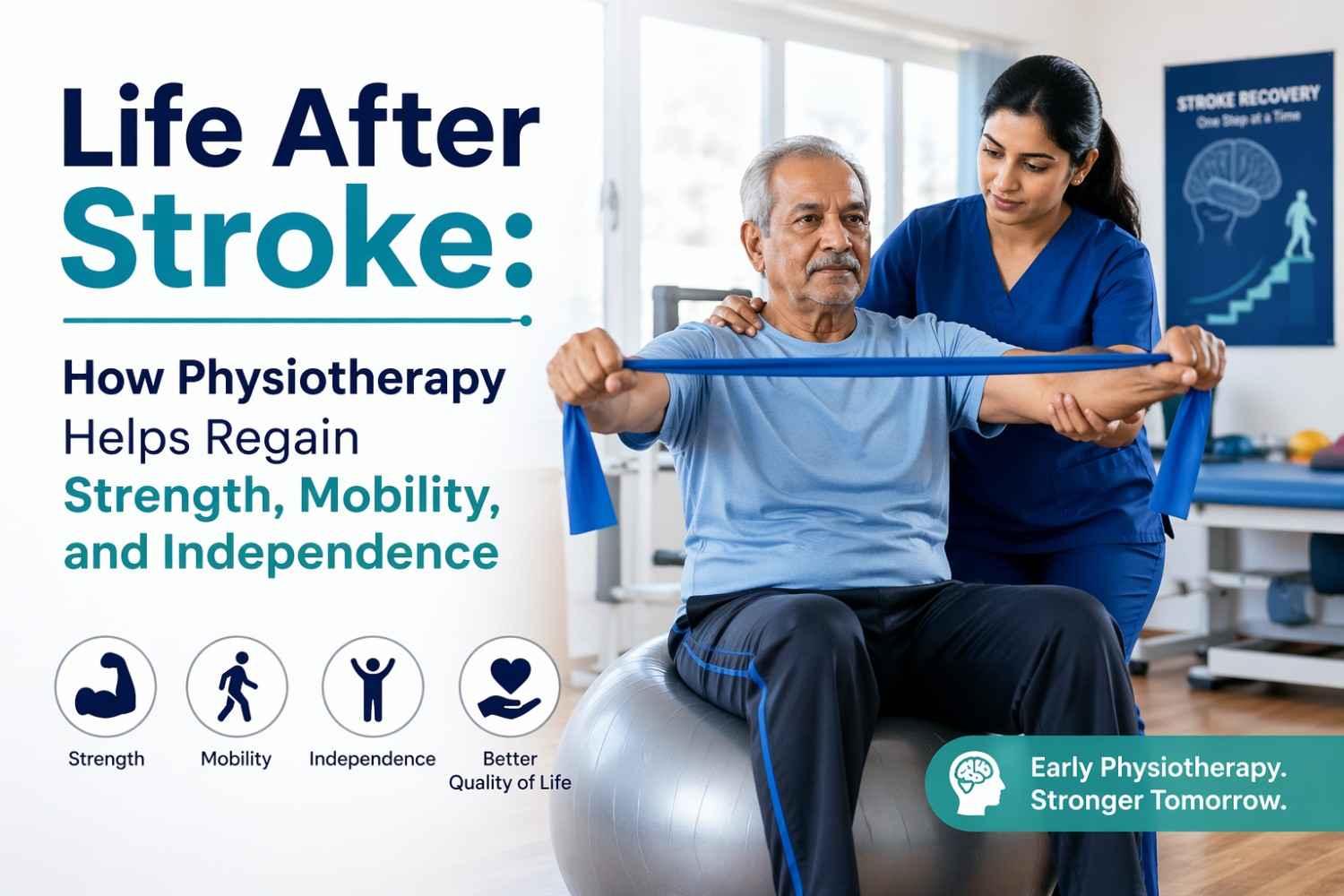
Life After Stroke: How Physiotherapy Helps Regain Strength, Mobility, and Independence


Dr. Krutika Bhadane
PT (Neuro), BPTh, MPTh (Neurosciences), 3+ years clinical
experience in neurological rehabilitation
Three days after her stroke, my patient's daughter told me she had stood outside the hospital room for almost five minutes before going in. She was not sure what she would find. Her mother was awake. Eyes open. She recognised her daughter the moment she stepped inside. And then the daughter looked down and noticed the left arm. Completely still. Resting beside her mother like it belonged to someone else.
Her mother had walked to the kitchen every morning to make chai. That left leg had carried her through decades of that routine. Now it was not responding at all.
"Will she walk again?" the daughter asked me. It is the question families ask more than any other. And I want to answer it honestly here, not with the kind of vague reassurance that sounds comforting in the moment but leaves you no better prepared for what comes next. The answer is: meaningful recovery is genuinely possible. But the pace at which you start rehabilitation, and the quality of that rehabilitation, will shape the outcome more than almost anything else. This article explains why, and what you actually need to know to give your loved one the best chance.
What Is Physiotherapy After Stroke?
Physiotherapy after stroke is a structured rehabilitation process in which a trained neurological physiotherapist works with the stroke survivor to restore movement, balance, strength, and the ability to manage daily physical tasks. It targets the specific damage the stroke caused to the brain's motor systems, using evidence-based exercises and hands-on techniques to help intact brain cells take over functions that were lost.
One thing worth saying clearly upfront: this is not the same as general exercise or basic mobility support. Neurological physiotherapy for stroke survivors is precise, goal-oriented work. It changes the brain. Not just the body.
Why Does a Stroke Take Away the Ability to Move?
When a stroke cuts off blood supply to part of the brain, cells in that region begin dying within minutes. If the damage reaches the motor cortex, which is the part of the brain responsible for planning and executing movement, or affects the neural pathways that carry signals down the spinal cord to the muscles, the result is weakness or paralysis on one side of the body.
This is called hemiplegia when there is complete loss of movement, or hemiparesis when it is partial. The side affected depends on where in the brain the stroke occurred. A stroke on the left side causes problems on the right side of the body. A stroke on the right affects the left side. This crossover happens because the motor pathways swap sides in the brainstem before descending to the limbs.
But movement is not just about strength. Stroke also disrupts balance, coordination, posture, and something called muscle tone, the background level of tension that keeps muscles ready to respond. Tone can drop completely (flaccidity) or shoot up abnormally (spasticity). Both interfere with recovery, and both are things a skilled physiotherapist manages from the very beginning.
Diagram showing how stroke in the left hemisphere affects movement on the right side of the body, and vice versa, relevant to stroke physiotherapy rehabilitation.
The Condition Most Articles Do Not Bother Explaining: Post-Stroke Spasticity
Here is something that gets glossed over in most stroke recovery guides, and it genuinely frustrates me as a clinician, because by the time families find out about it, the window to prevent the worst of it has sometimes already closed.
After a stroke, a significant number of survivors develop spasticity. This is an abnormal and persistent increase in muscle tone that causes stiffness, involuntary tightening, and resistance when you try to move the affected limb. You might notice the arm pulling inward at the elbow, the hand fisting, or the foot turning in and downward. It is not the patient being difficult or uncooperative. It is a direct neurological consequence of the stroke, caused by the brain losing its ability to regulate and inhibit muscle activity.
Research published in Neurology journal (2021) found that spasticity affects up to 43% of stroke survivors within the first year. Left unmanaged, it can lead to contractures, which means the muscle literally shortens and the joint becomes fixed in a deformed position. Once a contracture sets in, you cannot undo it with stretching alone. It can cause chronic pain, skin breakdown where the limb presses against itself, and the permanent loss of whatever functional movement had been returning.
What makes this particularly hard for families is the timing. Spasticity builds quietly in those first few weeks when you are still overwhelmed by discharge paperwork, medication schedules, and just trying to figure out the basic logistics of bringing someone home after a stroke. Most people are not watching for it. And by the time the curled arm or the stiff leg becomes obvious, weeks have gone by.
If you have noticed your loved one's affected arm pulling toward the chest, or their foot turning inward when you try to assist with standing, please do not assume this will sort itself out. That is a clinical sign that needs immediate physiotherapy assessment.
When Should Physiotherapy Actually Start?
The honest answer is within 24 to 48 hours of the stroke, provided the patient is medically stable. That is not an exaggeration for effect. It is what the clinical evidence supports.
The reason timing matters so much comes down to a process called neuroplasticity, which is the brain's ability to reorganise itself after injury. After a stroke, the healthy brain tissue surrounding the damaged area goes into a kind of heightened state. It begins forming new connections, looking for ways to compensate, rerouting signals through alternative pathways. According to a 2024 review published in Frontiers in Neurology, this neuroplastic activity is most intense in the acute phase, the first days and weeks after injury.
Physiotherapy works by giving the brain structured, repetitive signals to guide that reorganisation. Without it, the brain still tries to adapt, but it does so inefficiently, often reinforcing compensatory patterns that feel easier in the short term but make proper recovery harder later.
The first three months after a stroke are what neurological clinicians call the golden window. This is when the brain is most capable of rewiring itself, and when structured physiotherapy produces the greatest gains. A systematic review published in Stroke journal by the American Heart Association (2023) confirmed that starting physiotherapy within the acute phase is one of the strongest predictors of where the patient ends up functionally at six months.
Every week of delay during that golden window is a week the brain was ready to rewire but did not receive the input it needed. That is a very concrete clinical cost. Not abstract. Real and measurable.
Visual timeline showing the neuroplasticity golden window after stroke, from acute phase week 1 through chronic phase beyond 12 months, used in stroke rehabilitation planning.
What Most Blogs Tell You vs. What the Evidence Actually Says
Here is the gap between common advice and clinical reality:
| Topic | What Most Blogs Say | What Rarely Gets Said |
|---|---|---|
| When to start | Start physiotherapy early | The neuroplasticity window is time-sensitive; a delay of even 2 to 3 weeks measurably reduces rewiring potential |
| What physiotherapy treats | Weakness and walking | Spasticity, balance, posture, fatigue, and fall prevention are equally critical targets that basic guides consistently overlook |
| Therapy intensity | Regular sessions help | 45 minutes of daily physiotherapy produces dramatically better outcomes than two sessions per week; intensity is the single biggest variable within a family's control |
| Recovery ceiling | Most recovery happens in 6 months | Meaningful functional gains are documented well beyond 12 months with the right approach and technology |
| Indian context | Not mentioned | Most Indian stroke survivors receive no outpatient rehabilitation after discharge; the gap between hospital and home is exactly where recovery is lost |
| Emotional health | Briefly mentioned | Post-stroke depression directly slows neuroplasticity and affects 30 to 40% of patients; leaving it untreated is clinically similar to stopping physiotherapy altogether |
What Stroke Physiotherapy Actually Looks Like, Session by Session
Before any treatment begins, the physiotherapist carries out a detailed assessment using standardised tools like the Fugl-Meyer Assessment, which measures motor function across the upper and lower limbs, and the Berg Balance Scale, which evaluates sitting and standing balance. This tells the clinician exactly where the deficits are and how to prioritise the programme.
The techniques used in evidence-based stroke physiotherapy include the following.
Task-Specific Training
involves the patient repeatedly practising real, functional activities. Standing up from a chair. Reaching across a table. Taking three steps. Research published in Neurorehabilitation and Neural Repair (2022) found that repetitive task-specific training is one of the most reliably effective methods for rebuilding motor pathways, precisely because it activates the neural circuits that actually need to be strengthened, rather than generic muscle groups.
Constraint-Induced Movement Therapy (CIMT)
works by temporarily restraining the unaffected arm, which forces the weaker arm to attempt tasks it would otherwise avoid. This sounds counterintuitive and patients often find it frustrating at first. But the clinical evidence is strong. A Cochrane Review, updated in 2022, confirmed that CIMT produces significant upper limb improvements even in the chronic stage of stroke recovery, long after most patients have been told they should not expect more gains.
The Bobath or Neurodevelopmental Approach
is a hands-on facilitation method where the physiotherapist guides the patient through normal movement patterns, correcting compensatory strategies as they emerge and retraining the nervous system toward quality movement. This is particularly valuable in the early weeks when the patient has little active control and passive positioning and guided movement are doing most of the therapeutic work.
Gait Training and Supported Treadmill Rehabilitation
trains the pattern and rhythm of walking before full voluntary strength has returned. Research published in Stroke (2021) found that body-weight supported treadmill training significantly improves walking speed and endurance in stroke survivors, because it gives the brain repetitive, high-quality walking input even when the patient cannot yet walk independently.
Balance and Proprioception Training
addresses the often-overlooked dimension of knowing where your body is in space. Stroke frequently disrupts proprioception, the sensory feedback system that tells your brain where your limbs are without you having to look at them. Without this, even patients with returning muscle strength cannot walk safely or independently.
Spasticity Management
is an ongoing thread through all of the above. Graduated stretching, positioning protocols, orthotic devices, and where needed, referral for botulinum toxin injections in collaboration with the medical team, all play a role in keeping tone manageable so that functional training can continue.
How Much Physiotherapy Is Enough?
Most guides say "regular sessions" and leave it there. The clinical evidence is far more specific.
A 2023 meta-analysis in JAMA Neurology found that stroke patients who received at least 45 minutes of physiotherapy per day showed significantly better functional outcomes at six months than those on standard care of two to three sessions per week. The difference was not marginal. It was clinically meaningful in terms of both walking ability and independence in daily activities.
The World Health Organization's stroke rehabilitation guidelines set a minimum of 45 minutes of relevant physiotherapy per day during the acute and subacute phases of recovery.
In practical terms, a stroke survivor receiving one or two physiotherapy sessions per week as their sole rehabilitation input is significantly under-dosed relative to what the evidence recommends. The days between sessions are not rest days for the brain. They are days the brain is ready to rewire but is not being given structured input. This is precisely why home exercise programmes, supervised by trained caregivers, are not optional extras in stroke rehabilitation. They are a core part of meeting the therapeutic dose that recovery requires.
A Realistic Recovery Timeline, Week by Week
Infographic of stroke physiotherapy recovery timeline from week 1 through 12 plus months, showing expected mobility and strength milestones for stroke rehabilitation patients in India" style="width: 100%; height: auto; margin: 20px 0; display: block;">
| Timeframe | What Happens in the Brain | What to Realistically Expect |
|---|---|---|
| Week 1 to 4 | Peak neuroplasticity window; the brain begins forming new motor pathways around damaged tissue | Bed mobility improves; sitting balance begins to emerge; early standing with full support starts; spasticity is being actively monitored and managed |
| Month 1 to 3 | Rapid rewiring phase; motor cortex recruits adjacent healthy regions to compensate | Supported walking begins; partial grip strength returns; transfers from bed to chair become more independent |
| Month 3 to 6 | Consolidation phase; newly formed pathways are reinforced through consistent practice | Walking distance increases; upper limb function continues improving; activities of daily living such as bathing and dressing become partially independent |
| Month 6 to 12 | Plateau risk period if therapy becomes inconsistent; gains slow but remain achievable | Fine motor control improves; walking quality refines; fall prevention becomes a key focus; community mobility is the goal |
| 12+ Months | Chronic phase; neuroplasticity persists with the right kind of high-intensity input | AI-assisted tools, telerehabilitation, and CIMT continue to produce meaningful recovery beyond what was previously considered possible |
A 2024 review in Frontiers in Neurology found that approximately 65% of stroke survivors with hemiplegia show meaningful improvement in walking ability within the first year, with younger patients under 65 showing better outcomes on average. The most important clinical point here is the one that gets said least: recovery does not stop at six months, and it does not stop at twelve months. The chronic phase is not a ceiling. For many patients, it is an underserved opportunity that the right rehabilitation approach can still open up.
The India-Specific Reality Nobody Is Talking About
The Urban-Rural Gap in Physiotherapy Access
India has a severe shortage of trained neurological physiotherapists, and they are almost entirely concentrated in large cities like Pune, Mumbai, Delhi, Bengaluru, and Chennai. Research from PMC India has highlighted that a large proportion of stroke survivors in district towns and rural areas receive no formal physiotherapy at all after hospital discharge, not because their families do not care, but because there is simply no trained clinician within reach.
The consequences of this are not theoretical. When a stroke survivor spends the golden window at home with well-meaning but clinically untrained family members as their only rehabilitation input, preventable things happen. Spasticity goes unmanaged and becomes contracture. Compensatory movement patterns get reinforced. Falls happen. Pressure injuries develop. By the time the family reaches a rehabilitation centre weeks later, the clinical situation is significantly more complicated than it needed to be.
This is why neurological rehabilitation centres offering post-stroke physiotherapy in Pune cannot limit their responsibility to patients who can travel to the clinic. Training family caregivers properly and providing telerehabilitation to patients who cannot access in-person care are not add-ons. They are part of the clinical obligation.
Why Language in Physiotherapy Matters More Than People Acknowledge
The language dimension of stroke physiotherapy rarely gets the attention it deserves outside of speech therapy discussions. But think about what physiotherapy actually involves. Giving precise movement instructions. Explaining why a particular exercise matters. Motivating a patient who is exhausted and in pain and questioning whether any of this is worth it. None of that works well through a language barrier.
A physiotherapist who cannot communicate naturally in the patient's primary language, whether that is Marathi, Hindi, Kannada, or Telugu, will struggle to build the kind of therapeutic alliance that makes patients push through the hard days. A 2026 study published in Healthcare on rehabilitation challenges across India identified language and cultural barriers as significant and underreported obstacles to effective neurological care. For patients in Pune and the surrounding Deccan region, being able to work with a physiotherapist in Marathi or Hindi is not a convenience. It is a clinical factor that affects rehabilitation quality.
What Families Can Actually Do to Help Recovery
Family involvement in stroke rehabilitation is not a supportive gesture at the margins. It is clinically significant. Survivors who receive consistent, informed support at home between therapy sessions recover faster and hold their gains for longer. The key word is informed. Well-meaning but clinically incorrect help can slow recovery, not accelerate it.
What Caregivers Should Do
- Attend physiotherapy sessions periodically so you understand exactly what the exercises involve and can supervise them safely at home without guessing
- Help your loved one complete the home exercise programme prescribed by the physiotherapist, usually 20 to 30 minutes daily, consistently across the week, not just when it feels convenient
- Adapt the home environment carefully: clear trip hazards, add grab bars in the bathroom, ensure chairs are the right height for safe transfers
- Acknowledge every small gain openly. A cup held with the affected hand. A single step without the wall. These moments matter clinically, not just emotionally, because positive feedback and emotional motivation directly influence the neuroplastic process
- Report changes honestly to the physiotherapist: new pain, increased stiffness, any falls, anything that seems different
What Caregivers Must Avoid
- Completing tasks for the patient because it is faster or easier to do so; this removes the repetitive practice that the brain needs to rewire
- Rushing transfers or exercises; slow, quality movement is more neurologically valuable than quick, compensatory movement
- Comparing your loved one's recovery timeline to a neighbour's relative or a story from the internet; no two strokes are the same, and comparison usually causes harm without providing useful information
- Deciding that therapy should wait until the patient "feels stronger" or "is more ready"; the neuroplasticity window moves on whether the patient feels ready or not
- Dismissing early signs of spasticity, pressure redness, or increasing limb stiffness as normal; these need prompt clinical review
Family caregiver assisting a stroke patient with walking exercises at home as part of a post-stroke physiotherapy programme in India" style="width: 100%; height: auto; margin: 20px 0; display: block;">
What Technology Is Making Possible Now, in 2025 and Beyond
Telerehabilitation Is Not a Compromise
There is a perception, especially among older family members, that online physiotherapy is a lesser version of the real thing. The research does not support that view.
A 2025 systematic review published in World Journal of Advanced Research and Reviews, drawing on randomised controlled trial data from the past decade, found that telerehabilitation was equal to or better than traditional in-person physiotherapy for post-stroke patients across measures including walking ability, balance, and quality of life.
For families in Pune where the patient cannot travel easily, or for patients in surrounding districts without access to a neurological physiotherapist locally, this matters enormously. Telerehabilitation is not a fallback option. It is a clinically valid mode of care that also offers something in-person therapy cannot always provide: the ability to practise in the actual home environment where real daily function happens.
AI-Assisted Rehabilitation
A 2025 systematic review in PMC examined AI-powered rehabilitation platforms being used in stroke recovery and found consistent evidence that these tools can adjust exercise difficulty dynamically based on patient performance, deliver immediate corrective feedback through motion analysis and speech recognition, and substantially increase the volume of practice a patient gets between clinical sessions. For the chronic phase especially, where access to high-intensity in-person therapy becomes harder to sustain, AI-assisted tools are changing what is achievable.
Wearable sensors that monitor limb movement quality throughout the day, virtual reality environments that simulate real walking scenarios, robot-assisted devices that guide the affected arm or leg through precise movement patterns repeatedly, these are not distant possibilities. They are in clinical use now in neurological rehabilitation settings in India. The patients accessing them are seeing gains that standard therapy at lower doses was not producing.
The Emotional Health Connection Nobody Takes Seriously Enough
Post-stroke depression is one of the most under-addressed factors in physical recovery from stroke, and in my clinical experience, it is also one of the most damaging when it goes unrecognised.
Research consistently finds that depression affects 30 to 40% of stroke survivors. The reasons are both psychological and neurological. The sudden loss of independence, the inability to do things that previously defined daily life, the isolation that comes from communication difficulties or reduced mobility, these are genuinely devastating experiences. And on top of that, the stroke itself alters brain chemistry in ways that increase depression risk independently of circumstances.
The reason this matters beyond the emotional dimension is biological. A brain under sustained emotional distress has chronically elevated cortisol levels. Cortisol is actively harmful to the formation of new neural connections. A patient who is depressed is not simply struggling emotionally. They are, at a neurochemical level, less capable of the neuroplastic recovery that physiotherapy is trying to drive. Treating the depression is not a separate priority from the physical rehabilitation. It is part of it.
Families should watch for persistent withdrawal, loss of interest in physiotherapy that was previously tolerated, tearfulness, irritability without clear cause, or direct expressions of hopelessness. These are not character traits or signs of giving up. They are clinical symptoms. And they respond well to counselling, peer support, and a rehabilitation environment where the patient feels genuinely safe to try and fail without judgment.
At Apricot Care in Pune, stroke physiotherapy sits within a multidisciplinary programme that includes psychological support alongside physical rehabilitation, nutritional guidance, and structured caregiver training. This is not an upsell. It is how the evidence says stroke recovery actually works best.
Key Takeaways
- Physiotherapy after stroke should begin within 24 to 48 hours of the event once the patient is medically stable; the neuroplasticity golden window covers the first three months, and delay has a real, measurable clinical cost
- Spasticity is one of the most common and most preventable complications after stroke, affecting up to 43% of survivors; it needs to be identified and managed before it becomes contracture
- 45 minutes of physiotherapy per day is the WHO minimum for the acute and subacute phases; patients receiving two sessions per week are significantly below therapeutic dose
- Task-specific training, constraint-induced movement therapy, gait training, and spasticity management are among the strongest evidence-based techniques available in neurological physiotherapy
- Recovery does not stop at six months; with the right intensity and tools, the chronic phase of stroke recovery remains a genuine opportunity for functional gains
- India's urban-rural gap in access to neurological physiotherapy means most patients receive no structured rehabilitation after discharge; telerehabilitation is not a lesser option, it is a clinical solution
- Family caregivers are part of the rehabilitation team, and the single most helpful thing they can do is support daily structured practice rather than reduce demands on the patient
- Post-stroke depression affects nearly one in three stroke survivors and directly impairs neuroplasticity; psychological rehabilitation must run alongside physiotherapy, not wait until physical recovery is further along
Closing
Recovery after a stroke is not a clean arc from injury to normal. Families who have lived through it will tell you that. There are weeks where the gains are visible and motivating. And there are weeks where everything feels stuck and the work feels pointless. Those hard weeks are not a sign that recovery has stopped. They are a sign of how difficult and relentless the work actually is.
In over three years of neurological rehabilitation, the families I have seen achieve the most meaningful outcomes are not the ones who found some special treatment or had some genetic advantage. They are the families who started early, stayed consistent even when it was hard, and treated the whole person, not just the paralysed limb. They kept believing that the brain was still working, still trying, even when it was not obvious from the outside.
So here is a question worth sitting with today: if your loved one has had a stroke and has not yet started structured neurological physiotherapy, what is actually standing in the way of making that call? The golden window is not waiting for the right moment. And the brain's capacity to find a new path forward is more remarkable than most people are ever told.
Post-stroke physiotherapy, stroke rehabilitation in Pune, stroke recovery exercises, and neurological physiotherapy for hemiplegia are core services at Apricot Care, Kharadi, Pune. To book an initial assessment or learn more about our stroke rehabilitation programme, reach out to our team.
References
- Frontera WR et al. Neuroplasticity and functional recovery after stroke. Frontiers in Neurology, 2024.
- Veerbeek JM et al. Effects of physical therapy interventions for stroke. Stroke (American Heart Association), 2023.
- Kwakkel G et al. Intensity and timing of physical therapy in stroke rehabilitation. JAMA Neurology, 2023.
- Wissel J et al. Prevalence and management of spasticity after stroke. Neurology, 2021.
- Dobkin BH et al. Telerehabilitation and AI-assisted therapy in post-stroke rehabilitation. World Journal of Advanced Research and Reviews, 2025.
- Paulson S et al. Language and cultural barriers in neurological rehabilitation in India. Healthcare, 2026.
.webp)