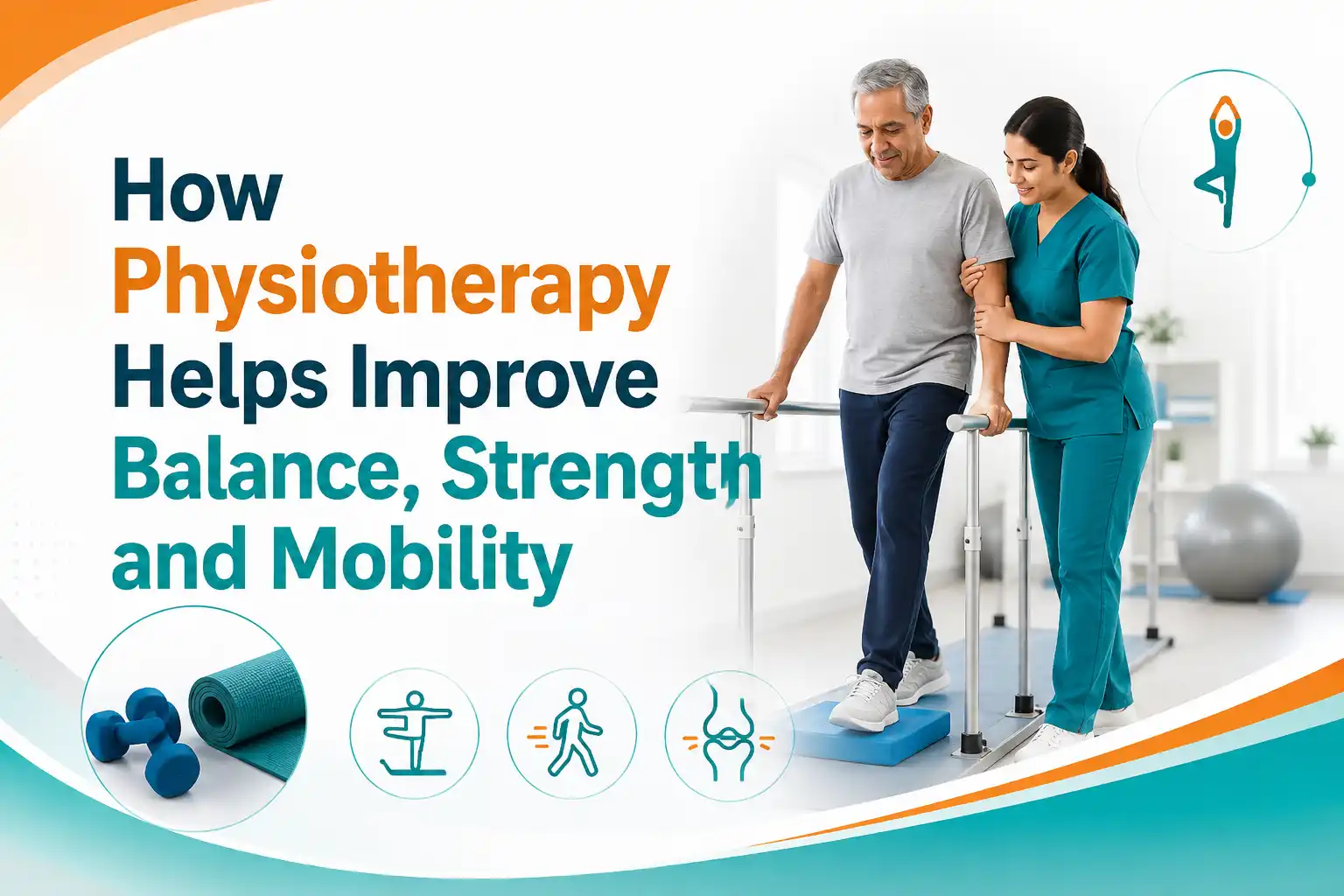
How Physiotherapy Helps Improve Balance, Strength and Mobility


Dr. Krutika Bhadane
PT (Neuro), BPTh, MPTh (Neurosciences), 3+ years clinical
experience in neurological rehabilitation
How Physiotherapy Helps Improve Balance, Strength and Mobility
Losing your balance, feeling weaker than you used to, or struggling to move around your own home confidently these changes can creep in gradually after a stroke, with Parkinson's disease, or simply with age, and it is easy to assume they are just something to live with. They are not. Rehabilitation physiotherapy built specifically around balance, strength and mobility is one of the most well-evidenced ways to reverse or slow this decline, and understanding how it actually works can make the difference between trying it half-heartedly and committing to a programme that genuinely changes your daily life.
What Do We Mean by "Balance," "Strength" and "Mobility" in Physiotherapy?
These three areas are closely linked but distinct, and a good physiotherapy programme addresses all of them together:
- Balance is your body's ability to control its position, whether standing still or moving, using input from your eyes, inner ear (vestibular system), and the sensory receptors in your muscles and joints (proprioception).
- Strength refers to the force your muscles can produce particularly in the legs, hips, and core, which do most of the work of keeping you upright and mobile.
- Mobility is your ability to move through the tasks of daily life: walking, transferring from sitting to standing, turning, and navigating obstacles.
A weakness or deficit in any one of these tends to affect the other two, which is why physiotherapy assessments look at all three together rather than treating "balance problems" or "weakness" in isolation.
How Balance Physiotherapy Actually Works
The Nervous System's Role
Balance is not a single sense it is your brain constantly combining information from your eyes, your inner ear, and sensory feedback from your feet, ankles, and joints, then issuing rapid postural corrections you are rarely even aware of. After a stroke, brain injury, or in conditions like Parkinson's disease, this processing can be disrupted at any point along that chain, which is why two people with "balance problems" can need very different training approaches.
Neuroplasticity: Why Repetition and Challenge Matter
Neuro physiotherapy relies heavily on neuroplasticity, the brain and nervous system's ability to reorganise and form new connections in response to practice. This is why balance and gait training is built around repeated, task-specific practice rather than passive treatment: the nervous system essentially "relearns" efficient movement patterns through consistent, appropriately challenging repetition.
What the Research Shows
The evidence base for physiotherapy's effect on balance is substantial and specific to condition:
- A systematic review and dose-response meta-analysis of physiotherapy for balance impairments in Parkinson's disease found moderate improvements overall, with balance-specific training producing the largest effect of any approach studied.
- Research into perturbation-based balance training where a person practises recovering from small, controlled losses of balance has repeatedly shown it reduces fall risk in both older adults and people recovering from stroke, by training faster, more effective automatic reactions.
- A meta-analysis of physiotherapy interventions in Parkinson's disease found that resistance training improved gait, treadmill training improved gait, and strategy-based balance and gait training improved motor symptoms, balance, and gait together while approaches like dual-task training alone showed less consistent benefit.
- The Berg Balance Scale, a standardised assessment used worldwide, remains the clinical gold standard for measuring balance changes over the course of treatment, allowing your physiotherapist to track real, measurable progress rather than relying on subjective impressions alone.
Common Techniques Used to Build Balance, Strength and Mobility
Gait and Task-Specific Training
Practicing the actual mechanics of walking including stepping, weight-shifting, and turning in a controlled, supported environment before progressing to less support and more real-world conditions.
Strength and Resistance Training
Targeted strengthening of the legs, hips, and trunk. This is relevant even for people with neurological conditions: research on strength training in stroke, Parkinson's, and multiple sclerosis shows it can meaningfully improve muscle strength, walking ability, balance, posture, and overall confidence in movement, alongside supporting the neuroplastic changes described above.
Balance-Specific Exercises
Progressive activities that challenge stability in a safe, supervised way from static standing balance to dynamic tasks like reaching, turning, or walking on varied surfaces gradually increasing difficulty as control improves.
Proprioceptive and Neurodevelopmental Techniques
Approaches such as proprioceptive neuromuscular facilitation (PNF) and neurodevelopmental treatment (NDT) focus specifically on retraining the sensory-motor connections that balance depends on, rather than only building raw strength.
Who Benefits from Balance, Strength and Mobility-Focused Physiotherapy?
- Stroke survivors, who often experience weakness or altered sensation on one side of the body affecting balance and gait.
- People with Parkinson's disease, where postural instability is a core and often disabling feature of the condition.
- People with peripheral neuropathy, where numbness or altered sensation in the feet directly undermines balance input.
- Older adults, whose balance, strength, and mobility decline gradually with age, increase fall risk even without a specific neurological diagnosis.
- Anyone recovering from a prolonged illness, hospitalisation, or surgery, where extended bed rest leads to significant deconditioning.
What to Expect from a Rehabilitation Physiotherapy Programme
A structured programme typically begins with a detailed assessment mapping your current balance, strength, coordination, and specific daily-activity limitations. From there, your physiotherapist builds a progressive plan using internationally recognised techniques, task-specific training, gait retraining, PNF, and NDT among them with clear, trackable milestones. Importantly, progress does not stop when the session ends: a home exercise programme and caregiver training (where relevant) are essential to keep gains moving between visits.
Building Better Balance, Strength and Mobility for Everyday Life
Balance, strength, and mobility problems are not simply something to accept, whether they follow a stroke, accompany Parkinson's disease, or develop gradually with age. Rehabilitation physiotherapy, grounded in an understanding of how the nervous system relearns movement, offers a structured, evidence-based path back to steadier, more confident daily function.
Book a Balance and Mobility Assessment in Pune
If balance, weakness, or mobility challenges are affecting your daily life or a loved one's, Book an assessment with the neuro physiotherapy team at Apricot Care, Kharadi, Pune to build a personalised, evidence-based recovery plan.
Frequently Asked Questions
How long does it take to see improvement in balance with physiotherapy?
This varies by condition and starting point, but many patients notice initial improvements in confidence and stability within a few weeks of consistent, supervised training, with continued gains over months for neurological conditions.
Can physiotherapy help balance problems that come with age, even without a specific diagnosis?
Yes. Age-related decline in strength, balance, and mobility responds well to targeted physiotherapy, and structured balance and strength training is one of the most evidence-supported ways to reduce fall risk in older adults.
Is balance training safe for someone who has already fallen or is very unsteady?
Yes, when supervised appropriately in fact, this is exactly the population that benefits most from a professionally guided programme, since exercises are chosen and progressed based on a person's actual risk level rather than a generic routine.
What is the difference between general physiotherapy and neuro physiotherapy for balance?
Neuro physiotherapy specifically addresses balance and movement problems arising from the brain, spinal cord, or nerves, using neurological rehabilitation techniques and an understanding of neuroplasticity, rather than general musculoskeletal treatment.
This article is for general educational purposes and does not replace an individual clinical assessment. Please consult a qualified physiotherapist or physician before starting a new exercise programme, particularly after a recent fall, stroke, or diagnosis.
Reference Links Used
https://pubmed.ncbi.nlm.nih.gov/32917125/
https://www.frontiersin.org/journals/neurology/articles/10.3389/fneur.2018.00980/full
.webp)