Wrist Drop: Causes, Symptoms and the Physiotherapy Treatment That Works


Dr. Krutika Bhadane
PT (Neuro), BPTh, MPTh (Neurosciences), 3+ years clinical
experience in neurological rehabilitation
Wrist Drop: Causes, Symptoms and the Physiotherapy Treatment That Works
One morning, a patient walks in unable to lift the back of the hand. The wrist hangs down. The fingers refuse to straighten. This is wrist drop, and it takes most patients by surprise because there is often little pain, yet the loss of hand function is immediate and frightening.
Wrist drop is not a disease on its own. It is a sign that the radial nerve, the nerve responsible for wrist and finger extension, has stopped sending proper signals to the muscles. The good news is that most cases of wrist drop respond well to physiotherapy, provided the treatment starts early and targets the right muscles in the right way.
In this guide, we explain what wrist drop is, why it happens, how to recognise the early signs of radial nerve palsy, and which physiotherapy treatment actually helps the hand recover. If you or a family member in Pune is dealing with this condition, understanding the nerve behind the symptom is the first step toward getting the hand working again.
What Is Wrist Drop? Understanding the Wrist Drop Nerve Connection
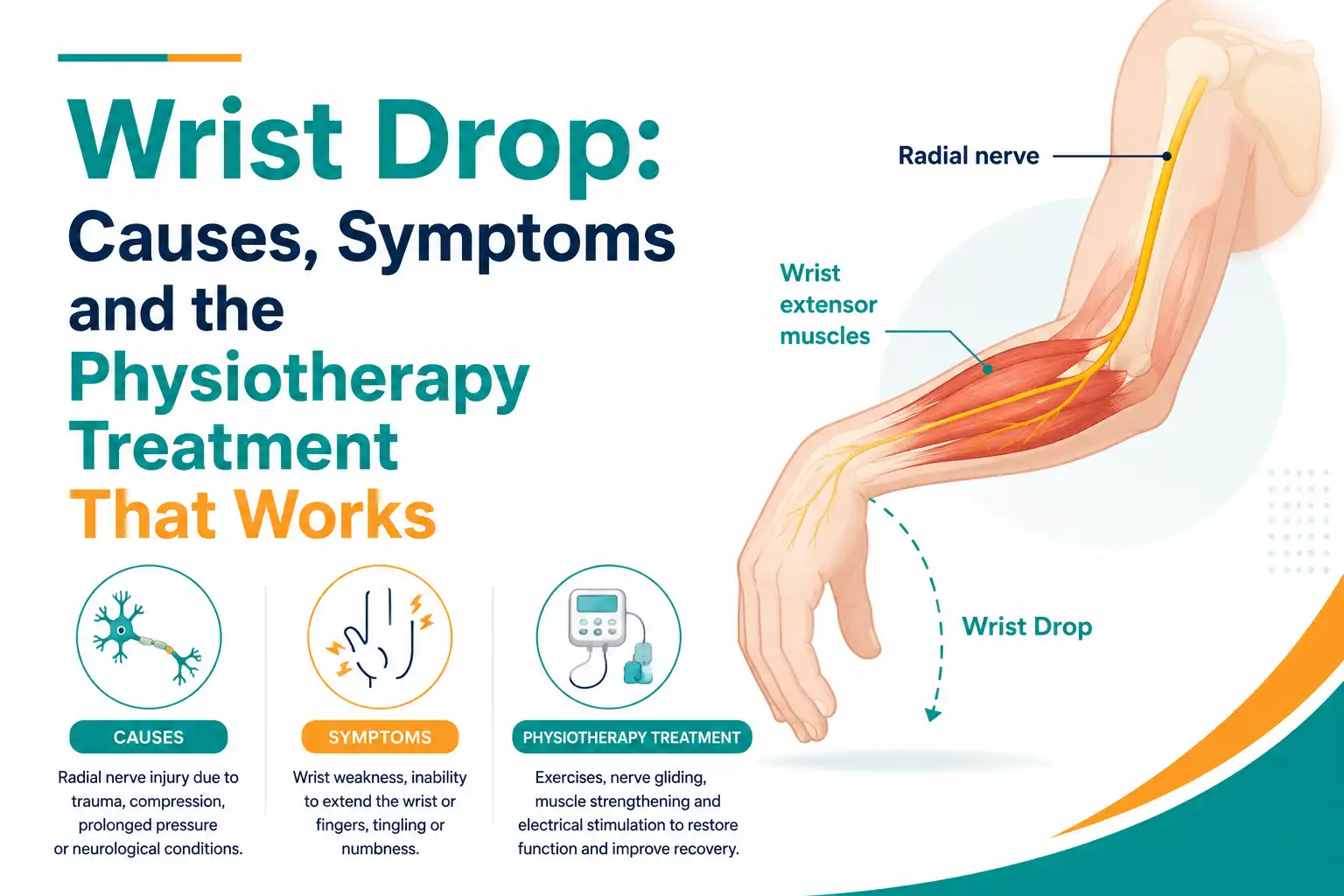
Wrist drop describes a hand that cannot extend at the wrist. The fingers droop too, and the whole hand hangs in a flexed position because the muscles that normally lift it are not working. This happens because of damage to the radial nerve, one of the three main nerves that supply the arm and hand.
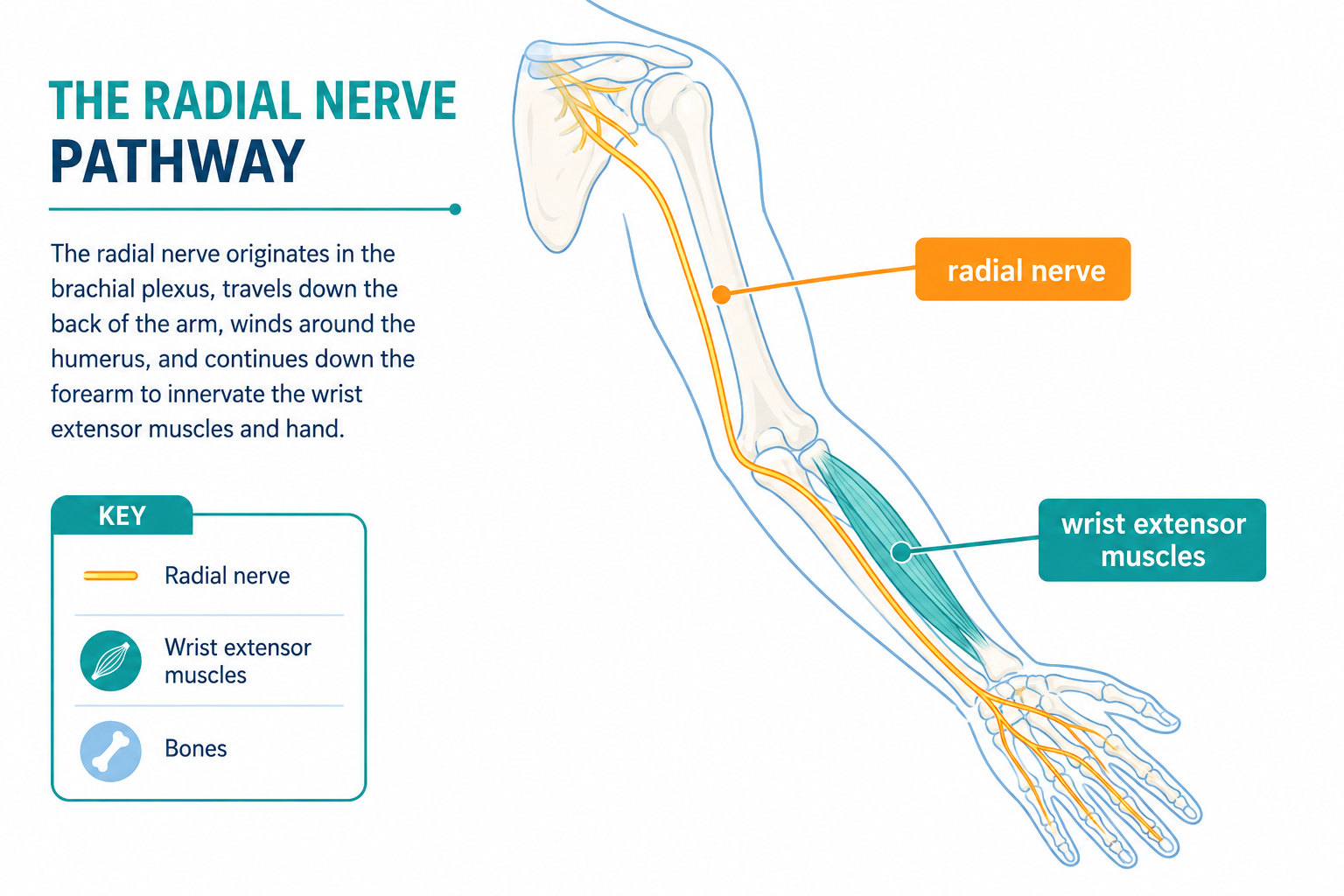
The radial nerve starts near the shoulder, travels down the back of the upper arm, and spirals around the humerus bone before reaching the forearm. Along this path, it supplies the triceps and every muscle responsible for extending the wrist and fingers. When the nerve is compressed, stretched, or cut anywhere along this route, the extensor muscles lose their signal. The opposing flexor muscles, which pull the wrist downward, then act unopposed. That imbalance is what produces the classic wrist drop position.
Doctors also call this condition radial nerve palsy. The two terms describe the same clinical picture: a wrist drop nerve problem centred on the radial nerve pathway.
Wrist Drop Causes: Why the Radial Nerve Stops Working
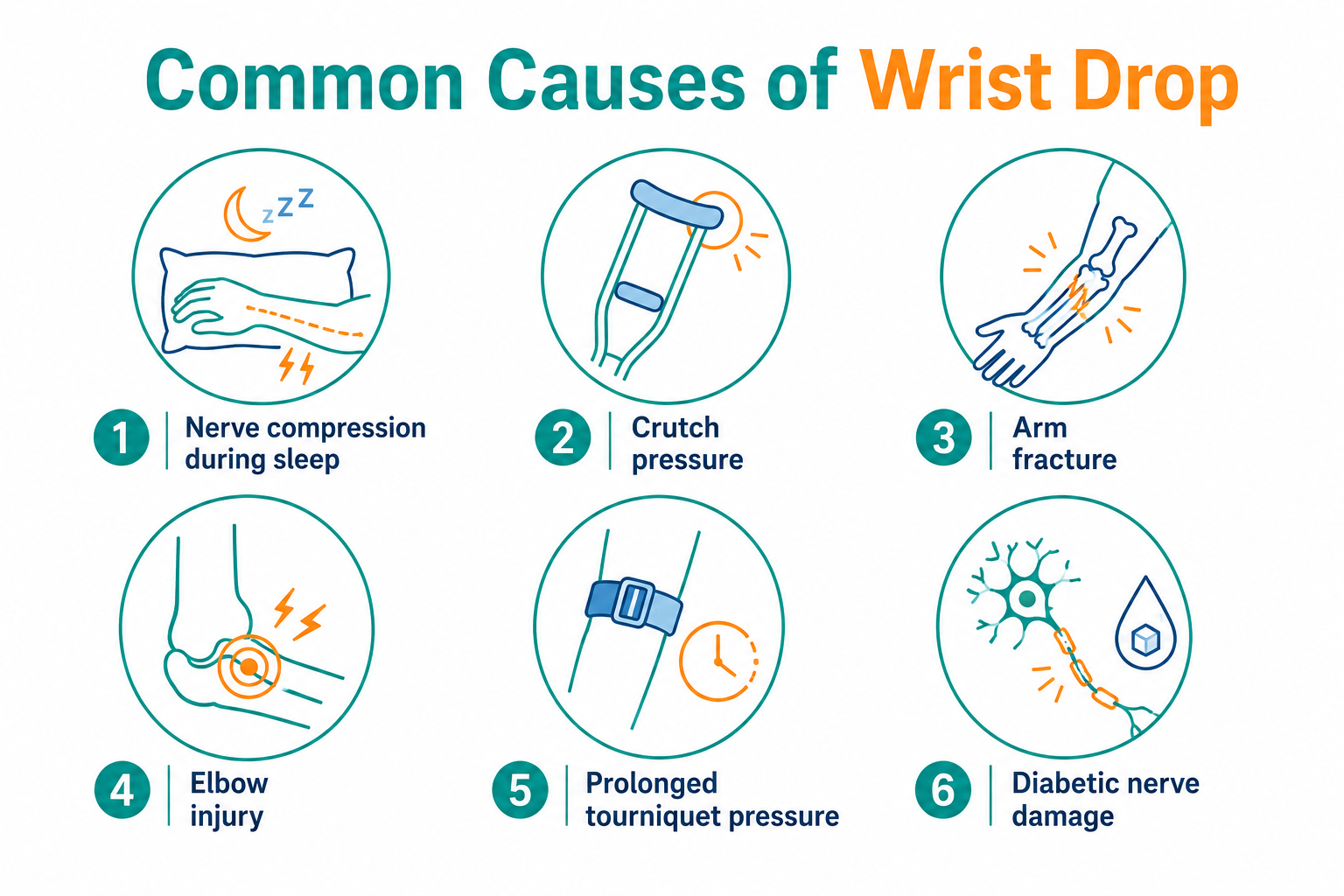
Wrist drop causes range from simple, temporary pressure on the nerve to more serious structural injuries. The most common causes include:
- Prolonged pressure on the nerve during sleep, often called Saturday night palsy, where the arm rests under the head or against a hard edge for hours
- Crutch pressure in the armpit from incorrect crutch use
- Fracture of the humerus, the upper arm bone the radial nerve wraps around
- Elbow dislocation or injury
- Prolonged use of a tourniquet during surgery
- Repetitive strain from certain occupational movements
- Diabetic neuropathy, where long-term high blood sugar damages peripheral nerves, including the radial nerve
- Lead poisoning, a rare but well documented cause
- In uncommon cases, a stroke affecting the motor area of the brain can produce a similar hand posture, even though the radial nerve itself is healthy
This last point matters. Because wrist drop can occasionally originate in the brain rather than the arm, a proper medical assessment should always come before starting any treatment plan.
Radial Nerve Injury and Wrist Drop: How the Two Are Linked
Not every radial nerve injury behaves the same way, and understanding the type of injury helps set realistic expectations for recovery.
- Neurapraxia is the mildest form, where the nerve is compressed but the fibres remain intact. This is what happens in Saturday night palsy, and recovery usually happens within a few weeks.
- Axonotmesis involves damage to the nerve fibres while the outer covering stays intact. Recovery is slower, often taking a few months, and physiotherapy plays a central role in maintaining muscle health during this period.
- Neurotmesis is the most severe form, where the nerve is completely torn. This usually needs a surgical opinion alongside physiotherapy.
A physiotherapist or neurologist can usually judge the likely severity from the clinical exam, and a nerve conduction study confirms it when needed. This classification is what decides how aggressive the physiotherapy programme needs to be and how soon strength should return.
Recognising Radial Nerve Palsy Symptoms Early
The earlier radial nerve palsy symptoms are recognised, the sooner physiotherapy can begin, and early physiotherapy generally means a faster, more complete recovery. Watch for:
- Inability to lift the wrist or straighten the fingers against gravity
- A hand that hangs limp when the arm is held out
- Weak grip strength, since a stable wrist is needed to grip firmly
- Numbness or tingling over the back of the hand and the web space between thumb and index finger
- Difficulty with everyday tasks such as holding a cup, typing, or buttoning a shirt
- Usually little to no pain, which is what often makes patients delay seeking help
Because the symptoms can look similar to other nerve or tendon problems, a clinical evaluation is the safest way to confirm the diagnosis.
How Wrist Drop Is Diagnosed
Diagnosis starts with a physical examination, checking wrist and finger extension strength, sensation over the back of the hand, and reflexes. A nerve conduction study and electromyography (EMG) help confirm exactly where along the radial nerve the problem lies and how severe it is. If a fracture, dislocation, or other structural cause is suspected, an X-ray or MRI may also be recommended.
A qualified physiotherapist or neurologist should always confirm the diagnosis and rule out other causes, including stroke, before treatment begins.
Wrist Drop Treatment: What Helps Recovery
Wrist drop treatment works best when it addresses the underlying cause and supports the nerve and muscles at the same time.
- Removing the source of compression, whether that is a poorly fitted crutch, a sleeping position, or a tight cast
- Managing an underlying condition such as diabetes, which affects nerve health
- Medical management for pain or inflammation where needed, along with nutritional support if a deficiency is contributing
- Physiotherapy, which forms the core of recovery in the overwhelming majority of cases
- Surgical referral, reserved for confirmed severe nerve injuries or fractures that need fixation
Radial nerve palsy treatment is rarely a single step. It is a combination of addressing the cause and rebuilding function through structured physiotherapy.
Wrist Drop Physiotherapy Treatment: The Programme That Restores Movement
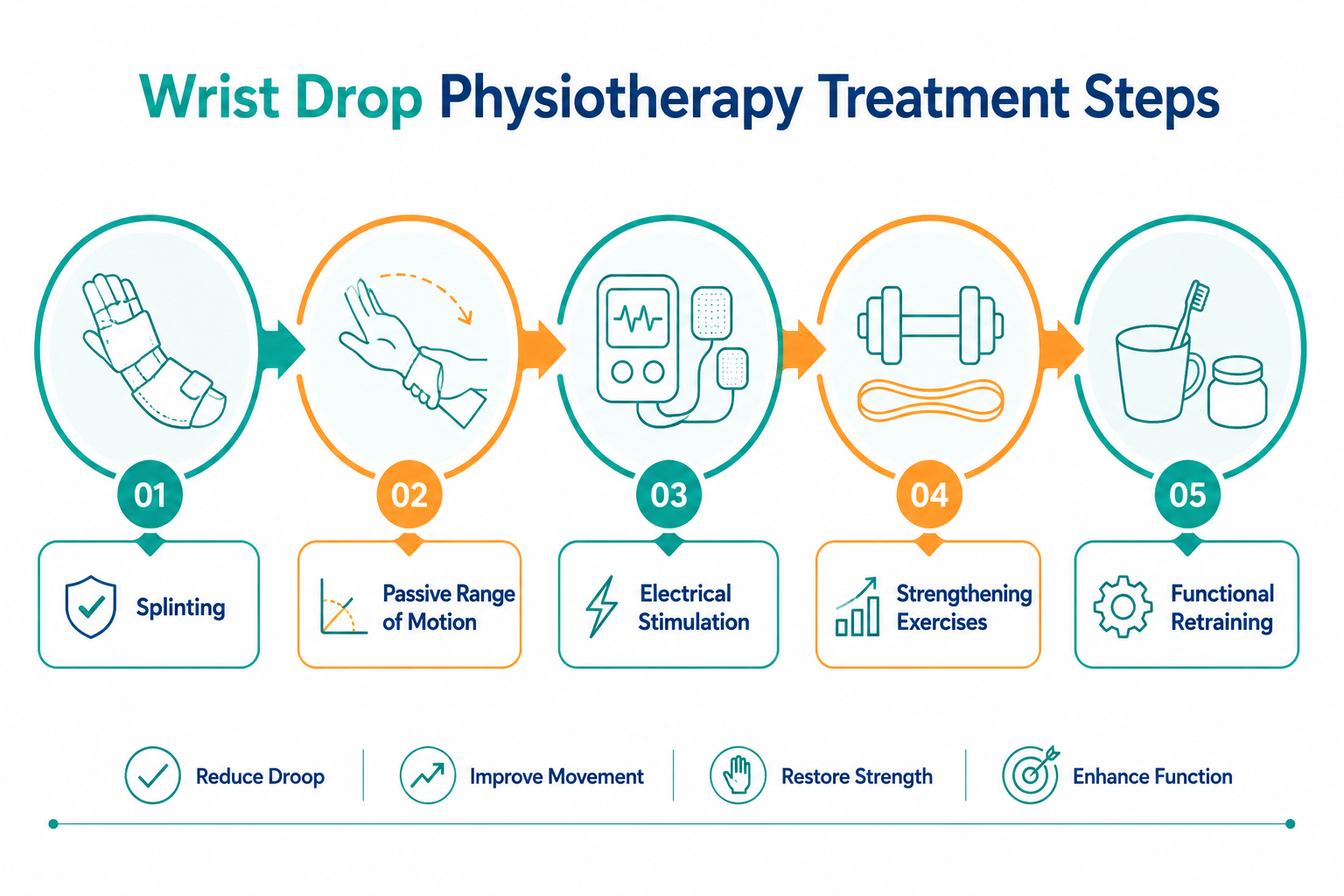
Wrist drop physiotherapy treatment is built around one goal: keep the hand functional and the muscles healthy while the radial nerve heals, then rebuild strength as the nerve recovers. A typical radial nerve palsy physiotherapy treatment plan includes:
- Wrist splinting: A cock-up splint holds the wrist in a neutral or slightly extended position. This protects the overstretched extensor muscles, allows the hand to grip more effectively, and prevents secondary stiffness.
- Passive range of motion exercises: While the extensor muscles cannot move on their own, a physiotherapist moves the wrist and fingers through their full range to prevent joint stiffness and maintain flexibility.
- Electrical stimulation: Targeted stimulation keeps the paralysed muscles active and slows the muscle wasting that happens when a muscle goes unused for weeks.
- Active-assisted and active exercises: As nerve signals return, even weakly, exercises progress to encourage the patient to move the wrist with gradually less support.
- Strengthening exercises: Once movement returns, grip and wrist extensor strengthening rebuilds the power needed for daily tasks.
- Functional retraining: Practising real tasks, such as holding objects, writing, and using cutlery, helps the brain and hand relearn coordinated movement.
- Sensory re-education: For patients with numbness, specific exercises help retrain the sensory pathways alongside the motor recovery.
This sequence is not rigid. A physiotherapist adjusts the plan based on how quickly the nerve is responding, which is why a professional assessment every few weeks matters more than a fixed home exercise sheet.
Wrist Drop Stimulation Points: Where and Why Electrical Stimulation Helps
One of the most frequently searched aspects of wrist drop treatment is where exactly the wrist drop stimulation points are placed. Electrical stimulation, typically through neuromuscular electrical stimulation or interferential current therapy, is applied over the extensor muscle group of the forearm, specifically the extensor carpi radialis, extensor digitorum, and extensor carpi ulnaris. These are the muscles responsible for lifting the wrist and straightening the fingers.
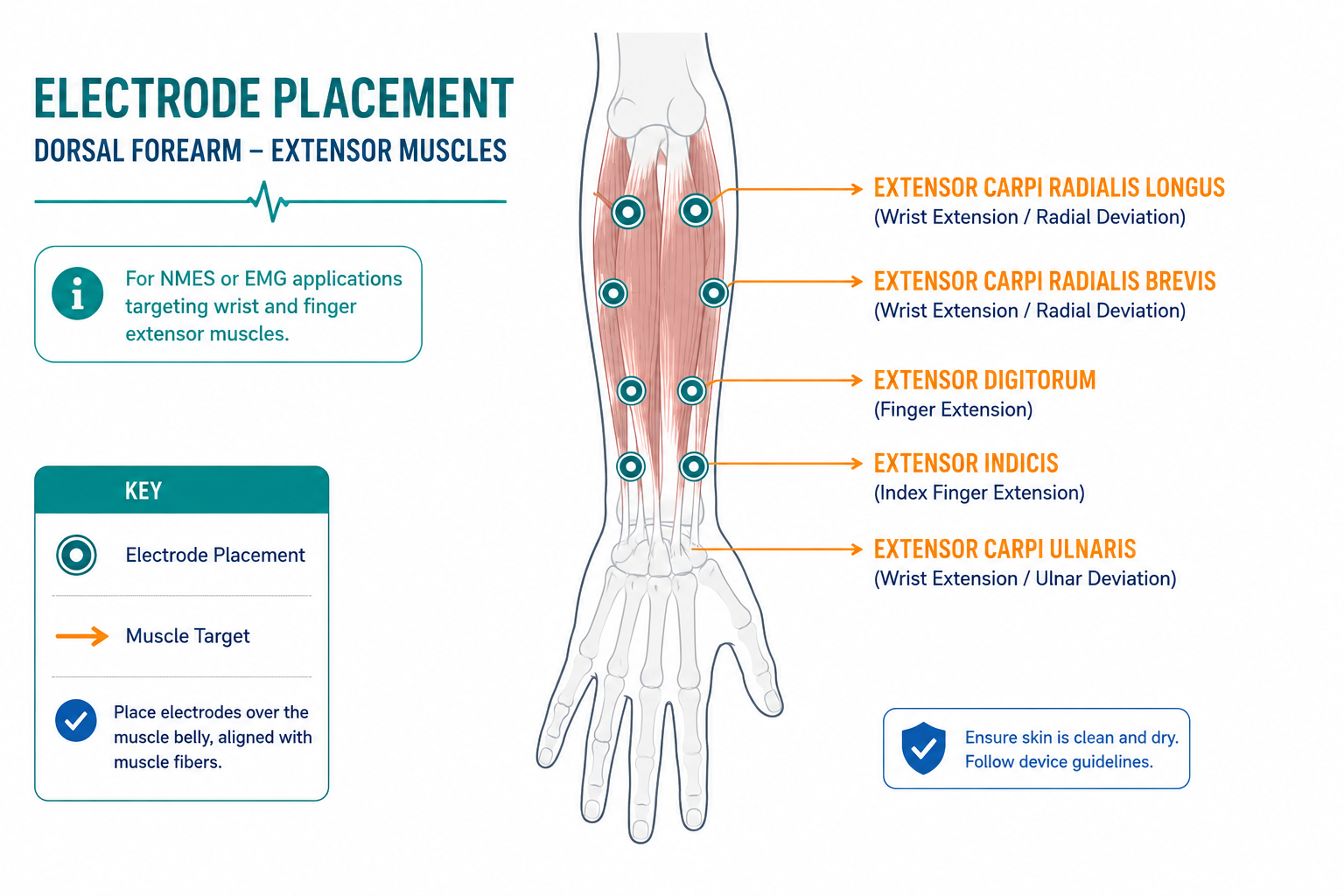
Correct electrode placement matters because stimulating the wrong point either fails to activate the target muscle or causes unwanted contraction in nearby muscles. A trained physiotherapist identifies the motor point of each muscle, the spot where the nerve enters the muscle and produces the strongest, most efficient contraction, before placing the electrodes.
The purpose of this stimulation is not to force movement through electricity permanently. It is to keep the muscle fibers active, maintain blood flow, and delay the muscle wasting that otherwise occurs while the radial nerve regenerates naturally, a process that can take weeks to months depending on the severity of the injury. Interferential therapy, one form of electrical stimulation used for this purpose, is generally well tolerated and pairs well with the manual exercises described above.
Because the technique depends on accurate placement and appropriate current settings, wrist drop stimulation should always be administered by a physiotherapist rather than attempted at home with a generic device.
How Long Does Wrist Drop Recovery Take?
Recovery time depends entirely on the cause and severity of the nerve injury. A mild compression injury, such as Saturday night palsy, often resolves within six to twelve weeks with consistent physiotherapy. Injuries involving significant nerve fibre damage can take three to six months, and severe injuries linked to fracture or nerve tear may take up to a year, sometimes longer if surgery is involved.
There are no shortcuts here, and any programme promising instant results should be treated with caution. What genuinely speeds recovery is consistency: attending physiotherapy sessions as scheduled, wearing the splint as advised, and continuing the home exercises between sessions.
When to See a Doctor
Seek medical attention promptly if:
- Wrist or hand weakness appears suddenly with no obvious cause
- Weakness is spreading to other parts of the arm or the opposite side of the body
- Wrist drop appears alongside slurred speech, facial drooping, or confusion, which needs emergency care
- There is no improvement at all after a few weeks of physiotherapy and home care
Early evaluation makes the difference between a nerve injury that recovers well and one that is missed until the muscles have wasted significantly.
Why Physiotherapy-Led Care Matters for Wrist Drop Recovery in Pune
Wrist drop responds well to treatment, but only when the physiotherapy is structured, progressive, and reviewed regularly. At Apricot Care in Kharadi, Pune, the physiotherapy team builds an individual plan for each patient with wrist drop, combining splinting, electrical stimulation at the correct motor points, guided range of motion work, and progressive strengthening as the radial nerve recovers. Patients unable to travel can also access home physiotherapy sessions across Pune, so consistency is never compromised by distance.
Conclusion
Wrist drop can feel alarming the first time it appears, especially because the hand loses function so suddenly. But in most cases, the underlying radial nerve injury is treatable, and physiotherapy is the single most important part of that treatment. Understanding the wrist drop causes, recognising the symptoms early, and starting a structured physiotherapy programme, including splinting and electrical stimulation at the right points, gives the hand the best chance of a full recovery.
Ready to Start Treatment?
If you or a family member is dealing with wrist drop or radial nerve palsy, do not wait for the weakness to settle on its own. Book a consultation with our physiotherapy team in Pune to get an accurate assessment and a treatment plan built around your recovery timeline.
Frequently Asked Questions
1. What is the fastest way to recover from wrist drop?
Consistent physiotherapy, started as early as possible, gives the fastest recovery. This includes wrist splinting, electrical stimulation over the extensor muscles, and progressive strengthening as the radial nerve heals. There is no way to speed up nerve healing itself, but the right physiotherapy prevents muscle wasting and stiffness that would otherwise slow the return of function.
2. Can wrist drop be permanent?
In most cases, no. Mild compression injuries usually recover fully within weeks. However, severe nerve injuries, especially those involving a complete tear or long-standing untreated compression, can leave lasting weakness if physiotherapy is delayed or the nerve does not regenerate fully. Early assessment and treatment significantly reduce this risk.
3. Is physiotherapy enough to treat wrist drop, or is surgery needed?
Most cases of wrist drop, particularly those from temporary nerve compression, recover fully with physiotherapy alone. Surgery is generally reserved for confirmed nerve tears, associated fractures needing fixation, or cases that show no improvement after an appropriate period of conservative treatment and nerve conduction testing.
4. How is radial nerve palsy different from other nerve injuries in the hand?
Radial nerve palsy specifically affects wrist and finger extension, producing the characteristic wrist drop. This is different from median or ulnar nerve injuries, which typically affect grip strength, thumb opposition, or finger spreading rather than wrist extension. The pattern of weakness helps a physiotherapist or doctor identify which nerve is involved.
5. What exercises can I do at home for wrist drop?
Gentle passive range of motion exercises, moving the wrist and fingers through their full range with the other hand, help prevent stiffness. However, home exercises should always follow a physiotherapist's guidance, since the wrong exercise at the wrong stage can overstretch weakened muscles or interfere with splint use.
6. Does electrical stimulation help wrist drop recovery?
Yes. Electrical stimulation applied at the correct motor points over the wrist and finger extensor muscles helps maintain muscle activity and reduces atrophy while the radial nerve regenerates. It works best as part of a complete physiotherapy programme rather than as a standalone treatment.
This article is for general information and does not replace an in-person assessment. Please consult a qualified physiotherapist or neurologist for a diagnosis and treatment plan suited to your condition.
.webp)