
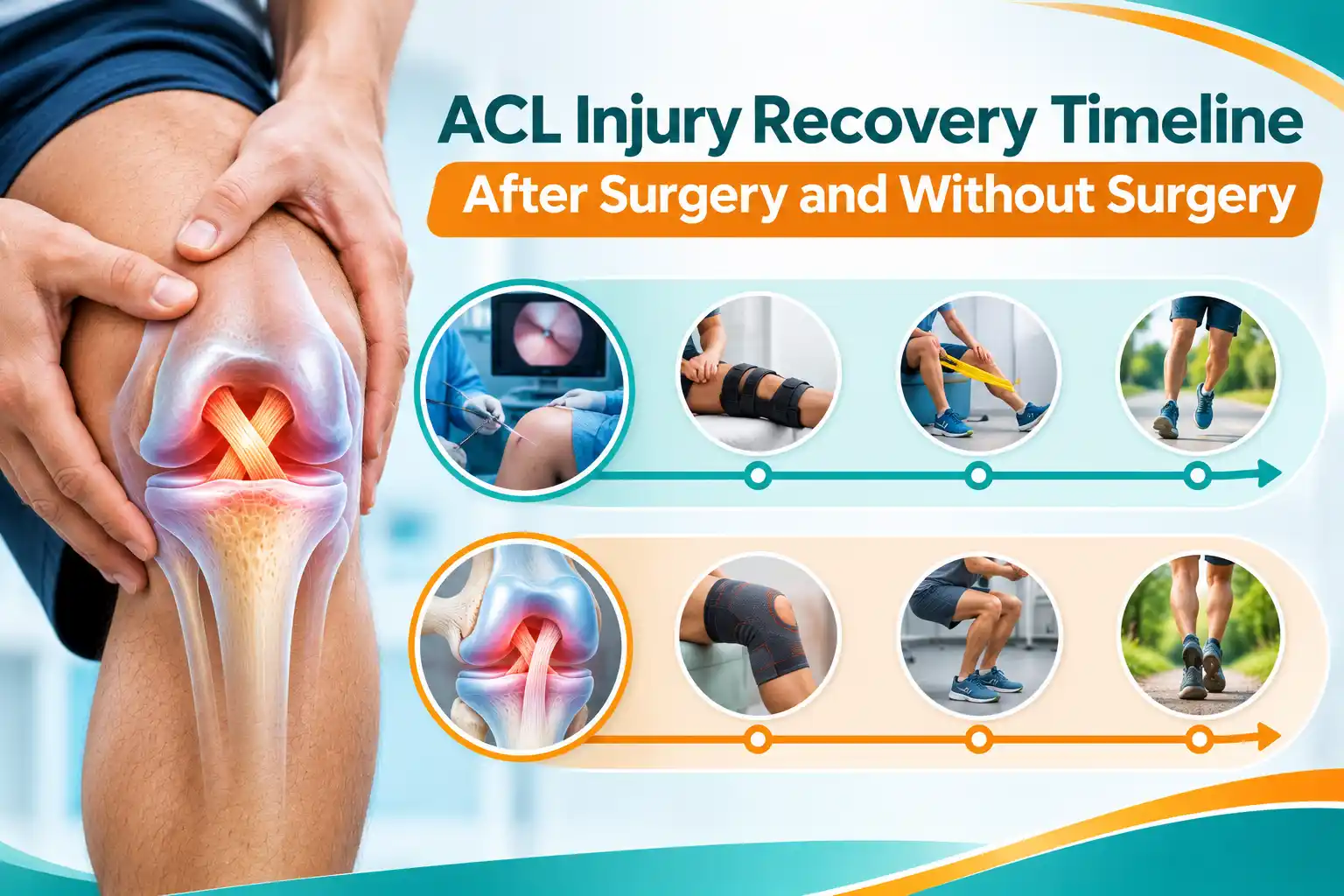
An ACL injury can make the next few months feel uncertain. You may be wondering when you can walk normally, return to work, start running or play football again. The ACL injury recovery timeline depends on whether you have reconstruction, whether a meniscus or other structure is injured, and how your knee responds to rehabilitation. A date on the calendar does not show whether the knee is ready to cut, jump or land safely. This guide explains the usual stages after surgery and without surgery, what progress looks like at each stage, and the warning signs that need medical review.
ACL Injury Recovery Timeline at a Glance
The early goal is to settle swelling, restore comfortable movement and walk safely. Strength and balance are built over the following months. Running and sport-specific drills come later, only when movement quality and clinical tests support them. After reconstruction, return to pivoting or contact sport often takes about 9 to 12 months or longer. These are broad guideposts, not permission to advance automatically when a month ends.
Rehabilitation without surgery also follows stages, but it does not use the same postoperative calendar. A person with a stable knee who wants to walk, cycle or do gym work may have different goals from a player returning to football. Both need an assessment of knee stability and any associated injuries. A meniscus repair, cartilage injury, graft choice or surgeon-specific precaution can change the pace after surgery.
Quick answer: How long does ACL recovery take?
Everyday function may improve over weeks to months. Returning to demanding sport after reconstruction commonly requires about 9 to 12 months or longer, plus strength, movement and sport-readiness testing.
If you are still unsure whether your injury involves the ACL, start with our ACL injury symptoms guide and arrange an appropriate knee assessment.
Before Choosing a Recovery Path
An ACL tear does not automatically mean surgery. The decision depends on episodes of giving way, the activity you want to return to, age and health, and injuries to the meniscus, cartilage or other ligaments. Some people function well with structured rehabilitation and activity adjustments. Others need to discuss reconstruction, especially if instability continues or their sport requires repeated pivoting.
Before an operation, a period of rehabilitation may help reduce swelling, restore knee extension and improve leg strength. If surgery is not planned, physiotherapy still matters: it helps you judge whether the knee can support your goals safely. Neither path should be chosen from an MRI report alone. A clinician should examine the knee and explain what the injury means for your specific activities.
The First Two Weeks After Injury or Reconstruction
In the first days after an injury, stop the sport, protect the knee and have significant swelling or instability assessed. After reconstruction, follow the surgeon's instructions for wound care, weight bearing, crutches and any brace. Early physiotherapy commonly focuses on pain and swelling control, gentle knee movement, getting the knee comfortably straight and activating the thigh muscles. The exact exercises and pace depend on the operation and any additional repair.
Walking may begin soon after surgery with help, but the goal is a safe, controlled pattern, not a race to discard crutches. A person who also had a meniscus repair may have different restrictions from someone who had an isolated ACL reconstruction. Do not force knee bending, straightening or full weight bearing beyond the plan you were given. Let the clinical team know if swelling rises sharply or movement becomes more difficult rather than gradually easier.
Quick answer: When can I walk after ACL surgery?
Many patients start walking early with physiotherapy guidance and may need crutches or a brace. Your surgeon's weight-bearing instructions, especially after an additional meniscus procedure, determine what is safe for you.
Weeks Two to Six Building Comfortable Daily Movement
During this stage, the focus often shifts toward better knee movement, improved walking and basic strength. A therapist may work on thigh, hip and calf strength, balance and controlled daily movements such as standing up or using stairs. Swelling should be watched: a knee that repeatedly becomes puffy after exercise may be receiving more load than it is ready for.
Returning to desk work or short errands can be possible before the knee is ready for heavy manual work or sport. Work timing depends on pain, travel, standing demands and the surgeon's restrictions. Driving requires enough control to perform an emergency stop and may be affected by which leg was operated on, medications and local rules. Ask your surgeon and insurer rather than following a generic online deadline.
Six Weeks to Three Months Rebuilding Strength and Control
As the knee tolerates more, rehabilitation usually becomes more demanding. Exercises may progress from supported movements to stronger leg work and single-leg control. The therapist checks whether you can move without the knee collapsing inward, whether the quadriceps are recovering and whether normal daily activities cause swelling afterward. The programme should also address the hip, calf and whole-body conditioning needed for your goals.
This is a common stage for feeling much better in daily life. That improvement is welcome, but it is not the same as readiness for football, badminton or sudden changes of direction. The reconstructed ligament and surrounding tissues continue to adapt, and strength or movement quality may lag behind how confident the knee feels. Keep the rehabilitation plan even when pain is low.
Three to Six Months Preparing for Running and Sport Drills
Running is usually introduced only when clinical milestones are met. A physiotherapist may check swelling, full or near-full movement, walking quality, strength and the ability to control single-leg tasks. A graded run-walk programme may then start, followed later by carefully planned jumping, landing and directional drills. The order depends on the patient's sport and the knee's response.
A calendar month does not override those checks. If the knee swells after a running trial, feels unstable, or movement quality worsens with fatigue, the plan may need to step back. Someone rehabilitating without surgery may also progress through running and controlled agility, but persistent giving way should prompt review of the treatment decision.
Quick answer: When can I run?
Running is a later-stage goal. It should begin after a clinician checks knee swelling, movement, strength and single-leg control, then approves a gradual programme; the month alone is not clearance.
Six to Twelve Months and Beyond Returning to Sport
Sport-specific training brings back acceleration, deceleration, jumping, landing and cutting in steps. Before full play, a clinician may compare leg strength, assess hop and landing tests, review knee swelling and ask whether you trust the leg during sport movements. Confidence matters alongside physical performance. A player who looks strong in one simple test may still need more practice under fatigue or in unpredictable situations.
For many people after ACL reconstruction, full return to pivoting or contact sport is considered around 9 to 12 months or later, provided the required milestones are met and the treating team clears it. Returning earlier can increase the chance of another injury, particularly in young athletes playing knee-demanding sports. No single test or month guarantees safety, so a staged return from training to full competition is sensible.
Quick answer: When can I return to football?
After ACL reconstruction, return to football often takes around 9 to 12 months or longer. Clearance should also depend on strength, landing and cutting control, sport-specific practice, knee response and your clinician's assessment.
What Changes the Timeline
A timeline can lengthen when a meniscus or cartilage injury requires extra protection, the knee remains swollen, full extension is slow to return, or quadriceps strength takes longer to rebuild. Infection, a blood clot, a new injury or repeated instability also changes the plan and may require medical care. Some people need more time to regain trust in the knee even after physical tests improve.
When Recovery Needs Medical Review
After surgery, contact your surgical team promptly for fever, wound discharge, increasing redness, worsening knee pain or swelling, or a painful swollen calf. Chest pain or difficulty breathing with leg symptoms needs emergency care. A knee that locks, repeatedly gives way or loses movement after an injury also needs assessment. These symptoms should not be explained away as normal exercise soreness.
Even without urgent signs, book a review if progress stalls for weeks, the knee swells after ordinary activity, or you cannot trust it on stairs. A therapist may change loading, check for another problem or coordinate with the surgeon. Clear communication is particularly important when an operation included more than ACL reconstruction, because the additional procedure may carry separate restrictions.
How Physiotherapy Supports Each Stage
The physiotherapist's role changes with the stage. Early visits focus on movement, swelling and safe walking. Later visits build strength and balance, then test running, jumping and sport tasks. Measurements give the patient and treating clinician a clearer picture than pain scores alone. A useful plan also includes home exercises and a way to adjust them when the knee reacts.
Learn about sports injury physiotherapy in Pune for graded rehabilitation and return-to-activity planning.
For recovery after reconstruction, see post-surgical physiotherapy at Apricot Care .
The orthopedic physiotherapy service also explains support for ligament and knee problems.
Frequently Asked Questions
How long does ACL injury recovery take?
There is no single recovery date. Daily activities may improve over weeks to months, while return to demanding sport after ACL reconstruction often takes about 9 to 12 months or longer. Rehabilitation without surgery also depends on knee stability, associated injuries and the activities you want to resume.
When can I walk after ACL surgery?
Many people begin walking soon after surgery with guidance and, if needed, crutches or a brace. The amount of weight allowed on the leg depends on the surgeon's instructions and any additional procedure, such as a meniscus repair. Do not use someone else's walking timeline as your clearance.
When can I run after ACL reconstruction?
Running may be introduced during a later rehabilitation phase when swelling is controlled and strength, walking and movement tests are satisfactory. A calendar month alone is not clearance. Your surgeon and physiotherapist should decide when a graded running programme is appropriate.
Can an ACL tear recover without surgery?
Some people regain good day-to-day function through structured rehabilitation without ACL reconstruction, particularly when the knee remains stable for their chosen activities. Others continue to experience giving way or have associated injuries and may need a surgical discussion. The plan should be individualised.
What tests matter before returning to sport?
A clinician may assess swelling, knee movement, strength, single-leg control, hopping, landing, sport-specific drills and confidence. Readiness is based on how the knee performs and the type of sport, alongside sufficient healing time and medical clearance.
How can Apricot Care help with ACL rehabilitation in Pune?
Apricot Care offers sports, orthopedic and post-surgical physiotherapy in Pune. After your injury or operation has been medically assessed, a physiotherapist can build a staged plan for movement, strength, balance and return to activity, while following your surgeon's precautions when applicable.
The Bottom Line
An ACL injury recovery timeline is a guide, not a promise. Early care protects the knee and restores movement; later rehabilitation builds strength, balance, running ability and sport-specific control. Some people do well without reconstruction, while surgery is appropriate for others. After reconstruction, demanding sport often takes around 9 to 12 months or longer, with clinical testing and clearance as well as time. Follow your own restrictions, and seek medical review for concerning symptoms or repeated instability.
For an ACL rehabilitation assessment in Kharadi, Pune, contact Apricot Care or call +91 73876 41462 . Seek urgent medical care first for the warning signs described above.
Medical Note: This article gives general information, not a personal rehabilitation schedule or clearance to return to sport. Your surgeon's restrictions and your physiotherapist's assessment take priority. Seek urgent medical care for signs of infection or a blood clot after surgery, and emergency care for chest pain or breathing difficulty.
References
- Recovery after ACL reconstruction and return to activities
- Complications and urgent symptoms after ACL surgery
- Clinical rehabilitation protocol after ACL reconstruction
- Clinical rehabilitation protocol without ACL surgery
- Patient guidance on ACL injury and rehabilitation options
- Study of early return to sport and second ACL injury risk
.webp)